Peristaltic pumps transfer liquids without touching them, which is why they are a standard tool for cell culture, chromatography, fermentation feeding, and reagent dispensing. This compact guide covers the working principle, key applications, selection criteria, and maintenance essentials for students, researchers, and procurement staff.
Key TakeawaysThe global peristaltic pump market is projected to grow at a 5.5% CAGR and reach USD 2.5 billion by 2030 (Grand View Research, 2025)
Rollers squeeze a tube to move fluid, so liquid only touches the tube wall, preventing cross-contamination.
Laboratory-grade pumps typically deliver ±0.5% to ±5% flow accuracy; high-precision dispensing reaches ±0.5% (John Morris Group)
Tubing is the only consumable; regular inspection and replacement prevent clogging and accuracy drift.t
How Does a Peristaltic Pump Work?
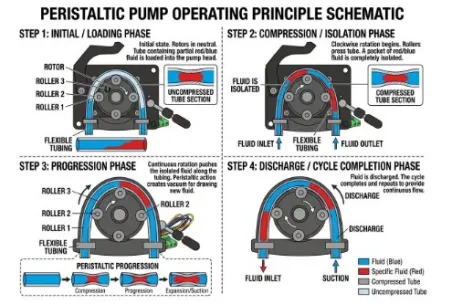
A peristaltic pump moves liquid through a squeeze-and-release cycle: rollers press a flexible tube in sequence, pushing fluid forward, and the tube springs back to draw in the next portion. Flow rate is roughly proportional to rotation speed, and it can also be changed by fitting tubing with a different inner diameter.
The pump has three parts: the drive, the pump head with rollers, and the tubing. The tubing is the only wetted component, so changing fluids simply means replacing the tube, with no pump-body cleaning and minimal cross-contamination risk. Common lab models cover flow rates from a few tenths of a milliliter per minute to several liters.
Why Are Peristaltic Pumps Essential in the Lab?
Because the fluid never touches mechanical parts, there are no stuck valves, corroded impellers, or leaking seals, which makes peristaltic pumps nearly irreplaceable in sterile and high-cleanliness applications (EV Process Manufacturing, 2025).
Three features matter most to labs: low shear for cell suspensions and protein solutions (VWR technical article), self-priming with dry-run tolerance, and bidirectional flow with easy cleaning. They also handle viscous, abrasive, or particle-laden liquids that would jam gear pumps or foul diaphragm valves.

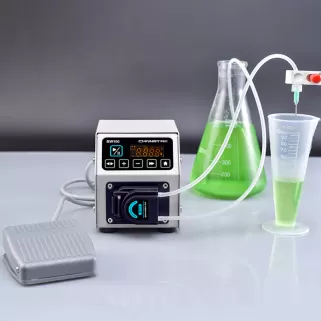
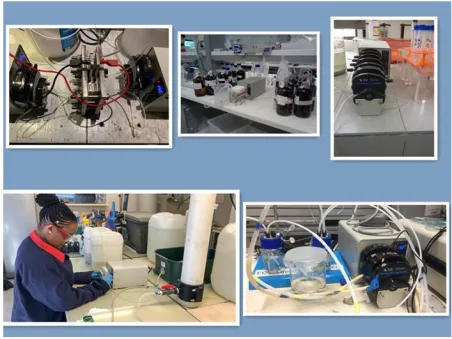
Image: Liquid handling in a chemistry laboratory (source: Pixabay)
Key Peristaltic Pump Applications in the Laboratory
Lab peristaltic pumps serve four main roles, and one pump can support several research groups at once:
Cell culture and fermentation: sterile media feeding, pH adjustment, and waste removal in fully closed, low-shear circuits.
Chromatography and purification: constant-flow sample loading, buffer delivery, and gradient elution; multichannel heads run several lines at once.
Reagent dispensing and sample prep: media preparation, buffer aliquoting, and standard dilution, with high-precision models reaching ±0.5% accuracy (John Morris Group).
Online monitoring and continuous-flow reactions: 24-hour stable injection for water analysis, flow injection analysis, and continuous-flow synthesis.
How to Choose a Peristaltic Pump for Your Laboratory
Selection is about four parameters, not the brand: flow range, accuracy, tubing compatibility, and control options.
Flow and accuracy: cover your max and min flow with a 30% margin. General transfer needs ±3% to ±5%; quantitative dispensing needs ±0.5% to ±1% models (John Morris Group).
Tubing material: match the chemical compatibility chart. Silicone suits aqueous and autoclavable use; PharMed BPT suits biopharma; Tygon covers many acids, bases, and alcohols; FEP offers the strongest resistance but wears faster. Check public databases from Saint-Gobain or Cole-Parmer.
Channels: single-channel pumps fit one liquid line; multichannel heads drive 4 to 12 tubes for parallel experiments.
Control: basic models use knob or keypad speed control; advanced models add digital flow setting, foot switches, and RS-485 or Bluetooth for automation.
Peristaltic Pump Maintenance Essentials
Tubing is the only consumable and the main source of accuracy, so maintenance focuses on it: replace tubing, calibrate flow, and keep the pump head clean.
Tube replacement: silicone tubing run continuously usually lasts a few hundred hours; inspect intermittent-use tubing every 1 to 3 months. Replace on cracks, whitening, deformation, or flow drops, and keep installed length identical.
Flow calibration: after every tube change, run at the set speed for 1 minute and correct the setpoint from the measured volume. Record temperature for high-precision work.
Cleaning and faults: wipe roller residues with water or ethanol. No flow means check tube seating or damage; low flow means tube fatigue; noise means roller bearings or compression.
Conclusion
An exchangeable tube buys sterile, low-shear, easy-to-maintain liquid transfer. Students should master tube installation, calibration, and replacement; researchers should put accuracy, tubing compatibility, and maintenance intervals into their protocols; procurement staff should compare models on flow range, accuracy, tubing compatibility, and control interfaces, with room to grow as the lab automates.
Frequently Asked Questions
Can a peristaltic pump handle organic solvents?
Yes, but only with the right tubing. Silicone tubing swells in solvents such as toluene and xylene, so switch to solvent-resistant materials like PharMed, Tygon, or FEP. Check the manufacturer's chemical compatibility chart before purchase.
What accuracy can a peristaltic pump achieve?
Laboratory-grade peristaltic pumps typically deliver flow accuracy of ±0.5% to ±5%: high-precision dispensing pumps reach ±0.5%, while general transfer runs around ±3% to ±5% (John Morris Group). Calibration and stable temperature satisfy most lab dosing needs.
How often should peristaltic pump tubing be replaced?
Under continuous high-speed operation, silicone tubing usually lasts a few hundred hours; for intermittent use, inspect it every 1 to 3 months. Replace tubing immediately when you see cracks, whitening, deformation, or a clear drop in flow.
Can a peristaltic pump be autoclaved?
Silicone tubing generally withstands 121°C steam sterilization, but pump heads and drives usually cannot be autoclaved as a whole. Remove the tubing and sterilize it separately, and confirm temperature ratings before buying.