Selecting an industrial high-flow peristaltic pump is not simply a matter of finding a pump with the highest flow rate. The right solution must also handle the fluid's viscosity, chemical properties, solids content, operating pressure, and required service life.
For industrial applications such as chemical processing, wastewater treatment, mining, and general manufacturing, choosing the correct pump can help improve process stability, simplify maintenance, and reduce operating costs.
This guide explains how an industrial high-flow peristaltic pump works, what applications it is suitable for, and which technical factors buyers should evaluate before making a purchasing decision.
What Is an Industrial High-Flow Peristaltic Pump?
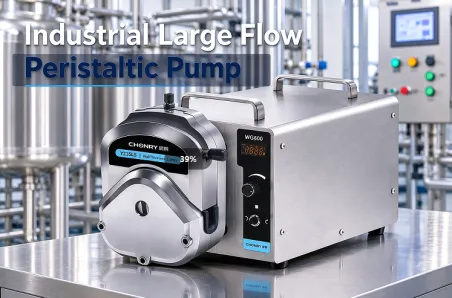
An industrial high-flow peristaltic pump is a positive displacement pump designed to transfer liquids by compressing a flexible tube or hose.
As the pump rotor rotates, rollers or shoes compress the tubing in sequence. This movement creates a traveling compression zone that pushes fluid toward the discharge side. The elastic recovery of the tubing helps draw additional fluid into the pump.
Unlike many conventional pump designs, the pumped liquid primarily contacts the inner surface of the tubing or hose.
This design makes peristaltic pumps useful for transferring fluids that may be corrosive, abrasive, viscous, sensitive to contamination, or contain suspended particles, depending on the pump configuration and tubing specifications.
A high-flow peristaltic pump is generally selected when a process requires a larger transfer volume than a standard low-flow metering pump can provide.
However, the term "high-flow" does not represent one universal flow-rate threshold. The appropriate capacity depends on the specific application and operating conditions.
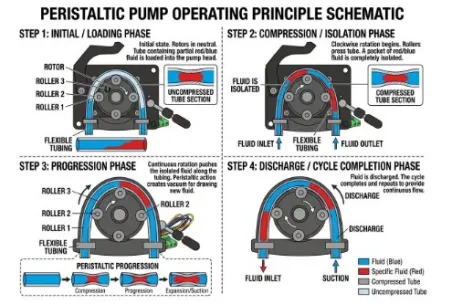
The operating principle is straightforward:
Fluid enters the pump: Liquid flows from the supply tank or process line into the pump tubing.
The rotor compresses the tubing: Rollers or shoes move along the tubing, creating successive compression zones.
Fluid moves forward: The rotating action displaces liquid through the tubing toward the outlet.
The tubing recovers: After compression, the tubing returns toward its original shape, helping create suction for the next pumping cycle.
Because pumping is achieved through mechanical compression of the tubing, flow is closely related to pump speed, tubing dimensions, and the displacement characteristics of the pump.
Actual flow can vary with operating pressure, tubing wear, fluid properties, pump configuration, and other conditions.
For this reason, buyers should always evaluate flow performance using the manufacturer's specifications for the intended operating point.
Key Advantages of Industrial High-Flow Peristaltic Pumps
1. The Fluid Contacts the Tubing
In a properly configured peristaltic pump, the transferred fluid contacts the inside of the tubing or hose rather than a conventional wetted impeller assembly.
This can simplify material selection for applications involving corrosive or sensitive fluids.
The tubing material must still be compatible with the liquid, its concentration, temperature, and cleaning requirements.
2. Suitable for Challenging Fluids
Depending on the tubing or hose size and pump design, an industrial peristaltic pump may handle:
Not every peristaltic pump is suitable for every fluid. Particle size, solids concentration, viscosity, and pressure requirements must be checked before selection.
3. Self-Priming Capability
Many peristaltic pump designs offer self-priming capability, making them useful in applications where the pump may need to draw liquid from a tank or process vessel.
Actual suction performance depends on lift height, tubing condition, fluid viscosity, air leakage, and pump configuration.
4. Simplified Routine Maintenance
Since the tubing or hose is a key wear component, routine maintenance can often focus on inspecting and replacing it when necessary.
This may reduce the complexity of maintenance compared with some other pump designs.
However, tubing replacement frequency depends on operating speed, pressure, chemical compatibility, temperature, and the nature of the pumped fluid.
5. Reversible Pumping in Suitable Configurations
Some peristaltic pumps can reverse flow by reversing the drive direction.
This feature can be useful for emptying lines, recovering residual liquids, or changing transfer direction.
The actual capability should be confirmed for the selected model and installation.
Common Industrial Applications of High-Flow Peristaltic Pumps
A high-flow peristaltic pump may be considered for a variety of industrial transfer tasks.
Chemical Processing
Chemical plants may need to transfer acids, alkalis, chemical solutions, additives, or other process liquids.
The main selection considerations include chemical compatibility, concentration, temperature, required flow rate, and discharge pressure.
Selecting the correct tubing material is especially important when handling aggressive chemicals.
Wastewater Treatment
Wastewater treatment facilities may use peristaltic pumps for transferring treatment chemicals, sludge-related fluids, and other process liquids.
For solids-containing fluids, buyers should evaluate particle size, solids concentration, viscosity, and the pump's ability to handle the actual material.
Mining and Mineral Processing
Mining operations may involve abrasive slurries, mineral suspensions, and process additives.
Peristaltic pumps may be suitable for selected slurry-transfer duties, but the abrasive characteristics of the fluid and the expected tubing or hose service life should be carefully assessed.
General Manufacturing
Industrial manufacturers may use peristaltic pumps to transfer coatings, adhesives, process liquids, and other specialty materials.
The pump should be selected according to the material's viscosity, required dosing or transfer accuracy, cleaning procedures, and production cycle.
How to Choose the Right Industrial High-Flow Peristaltic Pump
Before purchasing a high-flow peristaltic pump, consider the following six factors.
1. Determine the Required Flow Rate
Flow rate is usually the starting point for pump selection.
First, identify the actual volume of liquid that needs to be transferred and the available operating time.
Use the following formula:
Required Flow Rate = Total Transfer Volume ÷ Available Transfer Time
For example, if a process needs to transfer 600 liters within 30 minutes:
Required flow rate = 600 ÷ 30 = 20 L/min
In this example, the process requires an average flow rate of 20 L/min.
The selected pump should provide the required flow under the actual operating conditions, with appropriate consideration for process variability and future operating needs.
Do not select a pump based only on its maximum rated flow. A pump's maximum flow may be measured under conditions different from those in your application.
2. Confirm Operating Pressure
Discharge pressure is one of the most important factors affecting pump selection.
Before choosing a pump, identify:
Required discharge pressure
Static elevation difference
Pipeline length and diameter
Pipe fittings and valve resistance
Filters or other downstream equipment
Any pressure fluctuations during operation
The pump must be suitable for the total system pressure.
Do not assume that a pump can deliver its maximum flow rate at its maximum pressure rating. Flow and pressure performance must be evaluated together.
Also verify the pressure ratings of the pump head, tubing or hose, connections, and accessories.
Evaluate Fluid Viscosity and Solids Content
Fluid characteristics can significantly affect pumping performance.
Important questions include:
Is the liquid water-like or highly viscous?
Does it contain suspended particles?
What is the maximum particle size?
Is the fluid abrasive?
Does the viscosity change with temperature?
Is the material sensitive to mechanical stress?
A high-flow peristaltic pump may be suitable for certain challenging fluids, but the final selection must be based on the pump's actual capabilities.
For slurry applications, provide the manufacturer with representative fluid information rather than relying on a general description such as "mud" or "slurry."
Select the Correct Tubing Material
Tubing selection affects chemical compatibility, durability, and maintenance costs.
The correct tubing material depends on the fluid composition, temperature, pressure, and operating conditions.
When evaluating tubing, consider:
Chemical resistance
Operating temperature
Pressure requirements
Flexibility and fatigue resistance
Abrasion resistance
Expected replacement interval
Availability of replacement tubing
A tubing material that performs well with one chemical may not be suitable for another, even when both liquids appear similar.
For demanding applications, request compatibility confirmation from the pump or tubing manufacturer.
5. Choose the Appropriate Drive System
The drive system determines how the pump is operated and controlled.
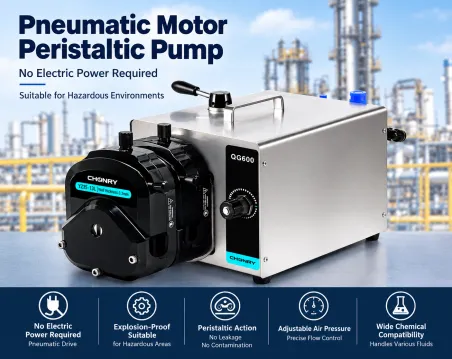
Electric motor-driven peristaltic pumps are commonly considered for industrial transfer systems requiring continuous or adjustable operation.
Depending on the application, buyers may need to evaluate:
If variable flow is required, confirm whether the selected model supports speed adjustment and how its flow changes with speed.
For hazardous locations, verify the applicable certification and protection requirements for the complete installation, including the motor, controls, electrical components, and other equipment.
A pump should not be considered suitable for an explosion-hazardous environment simply because it is described as industrial-grade.
6. Consider Maintenance and Total Cost of Ownership
The purchase price is only one part of the overall cost.
For an industrial high-flow peristaltic pump, total operating cost may include:
For applications with frequent operation, tubing service life can have a significant effect on total cost.
Ask the manufacturer for recommended inspection intervals, tubing replacement guidance, and spare-part availability.
How Much Flow Can an Industrial High-Flow Peristaltic Pump Deliver?
There is no single flow rate that defines every industrial high-flow peristaltic pump.
Available flow capacity depends on several factors:
Larger tubing and higher operating speeds may increase flow capacity, but they can also affect pressure performance, tubing life, and maintenance requirements.
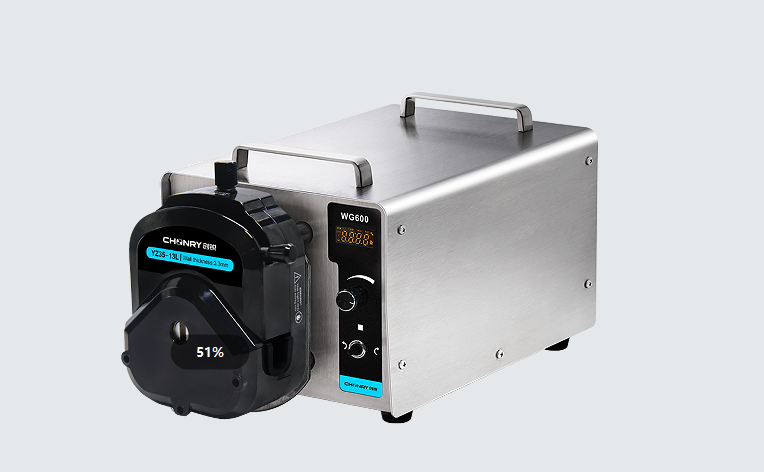
For example, CR Pump's published WG600 product information lists a maximum flow rate of 12 L/min and a speed of 600 rpm.
These figures refer to the published product information and should not be interpreted as guaranteed performance under every application condition.
For the latest model configuration and technical details, refer to the manufacturer's product page:
WG600 Large Flow Transmission Peristaltic Pump
When comparing models, request a performance confirmation for your required flow rate, operating pressure, tubing configuration, and fluid characteristics.
High-Flow Peristaltic Pump vs. Other Industrial Pump Types
Different pump technologies are suitable for different applications.
| Pump Type | Potential Advantages | Important Considerations |
|---|
| Peristaltic pump | Fluid primarily contacts the tubing; useful for selected corrosive, abrasive, or solids-containing fluids | Tubing wear, pressure limits, and replacement costs |
| Centrifugal pump | Often suitable for continuous transfer of compatible, relatively low-viscosity liquids | Performance depends on system conditions; fluid properties and solids may limit suitability |
| Diaphragm pump | Available in designs suitable for chemical transfer and demanding industrial services | Pulsation, air or drive requirements, maintenance, and flow characteristics vary by design |
| Gear pump | Can be suitable for certain viscous liquids and controlled transfer applications | Fluid cleanliness, abrasiveness, viscosity range, and material compatibility require evaluation |
No pump type is universally best.
A centrifugal pump may be a practical option for a large-volume water-transfer application. A peristaltic pump may be a better candidate when fluid isolation, tubing compatibility, or particular slurry-handling characteristics are important.
Can a peristaltic pump run continuously?
Some models are designed for continuous industrial operation, while actual suitability depends on the pump configuration and operating conditions.
Before selecting a pump for continuous duty, verify the rated duty cycle, operating speed, pressure, temperature, and maintenance requirements.
How do I calculate the required pump flow rate?
Divide the total transfer volume by the available transfer time.
For example, transferring 1,200 liters in 60 minutes requires an average flow rate of 20 L/min.
The selected pump must be capable of achieving the required flow under actual operating conditions.
How often should peristaltic pump tubing be replaced?
There is no universal replacement interval.
Tubing life depends on operating speed, pressure, chemical compatibility, temperature, fluid characteristics, and the pump's compression mechanism.
Regular inspection and manufacturer-recommended maintenance are essential.
How do I choose a pump for an explosion-hazardous environment?
Start by identifying the hazardous-area classification and the applicable local regulatory requirements.
Then verify the required certifications and protection levels for the pump system, including the drive motor, electrical equipment, controls, and installation accessories.
Confirm suitability with the manufacturer and the responsible site safety professional before installation.
Conclusion: Choose a Pump Based on the Complete Application
Choosing the right industrial high-flow peristaltic pump requires more than comparing maximum flow rates.
The most important selection factors are required flow, operating pressure, fluid properties, tubing compatibility, drive configuration, maintenance needs, and total cost of ownership.
By defining these requirements before requesting a quotation, industrial buyers can identify a more suitable pump configuration and reduce the risk of costly selection errors.
CR Pump provides peristaltic pump solutions for industrial fluid transfer applications.
Explore the available models:
Need help selecting an industrial high-flow peristaltic pump?
Prepare your required flow rate, operating pressure, fluid information, temperature, and operating schedule before contacting our team for a suitable pump recommendation.
The best choice depends on the process requirements rather than the pump category alone.
Example: Evaluating a High-Flow Pump for an Industrial Application
Consider a hypothetical chemical-transfer application with the following requirements:
Required transfer volume: 600 liters
Available transfer time: 30 minutes
Required average flow: 20 L/min
Fluid: Industrial process liquid
Operation: Repeated production cycles
The first step is to establish whether a pump can provide 20 L/min under the required discharge pressure and fluid conditions.
The next step is to confirm chemical compatibility and tubing service life.
The selection process should then evaluate motor specifications, control requirements, installation conditions, and maintenance expectations.
A pump with a published maximum flow rate above 20 L/min is not automatically the correct choice. Its performance at the required pressure and operating conditions must also be verified.
Likewise, a model rated below the required flow should not be assumed suitable without a confirmed alternative configuration or operating arrangement.
This approach helps buyers avoid selecting equipment based on a single headline specification.
Frequently Asked Questions
What is considered a high-flow peristaltic pump?
There is no universal industry threshold for high flow.
The term generally describes a peristaltic pump designed to deliver a relatively large volume of liquid for its intended application. The required flow rate should be defined by the process rather than by the marketing term alone.
Can a high-flow peristaltic pump handle viscous liquids?
Yes, certain models can handle viscous liquids.
However, pump selection depends on viscosity, suction conditions, tubing size, speed, pressure, and fluid behavior.
Very viscous materials may require a different configuration or operating approach.
Can a peristaltic pump transfer abrasive slurry?
Some industrial peristaltic pumps are designed for selected abrasive slurry applications.
The maximum particle size, solids concentration, particle shape, and abrasive characteristics should be confirmed with the manufacturer.
Tubing or hose wear should also be considered when evaluating operating costs.