The Mechanics of Isolation: Understanding the Peristaltic Working Principle
Contamination is the failure mode that ends batches. A trace of lubricant, a scrape of metal oxide, a residue from the last chemical that passed through a valve seat — any of these can invalidate a sterile fill or corrupt a biological assay. The peristaltic pump answers this problem at the level of geometry rather than procedure.
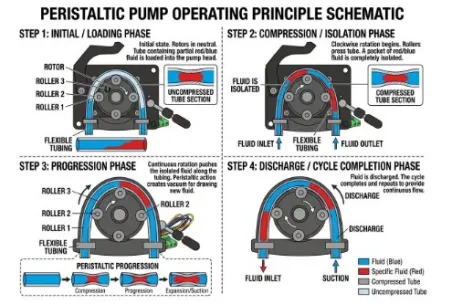
A peristaltic pump is a positive displacement device in which rotating rollers or shoes progressively occlude a flexible tube, driving a discrete slug of fluid toward the discharge while the restitution of the tube behind each roller generates the vacuum that draws in the next charge. There are no valves, no seals, no impellers, no pistons in the fluid path.
Picture the rotor head in cross-section: a circular track, two or three rollers mounted on a spinning arm, and the elastomeric tube pressed between roller and track wall. As a roller advances, the pinch point travels with it, carrying the trapped volume forward. The wetted path consists of the tube bore and nothing else — the pharmaceutical and biotechnology sectors account for roughly 40% of sales for leading fluid technology groups for precisely this reason, and those same groups held a statutory operating profit margin of 23.0% in 2024. Non-occlusive head designs now deliver up to an 85% reduction in pulsation, and industrial metering spans 25ml/min to 65L/min. The valveless architecture also passes solids and slurries that would jam a check valve, which is the second half of the isolation argument and the core of the peristaltic pump working principle.
Precision Dosing: Calculating Flow Rates and Managing Pulsation
Peristaltic flow is deterministic. Each rotor revolution displaces a fixed volume, so output is a product of geometry and speed rather than a function of downstream pressure. The governing relationship for peristaltic pump flow rate calculation is straightforward:
Q = V_rev × N × η, where V_rev is the volume displaced per revolution (a function of tube internal diameter and the effective pumping length of the track), N is rotor speed in RPM, and η is the occlusion efficiency factor.
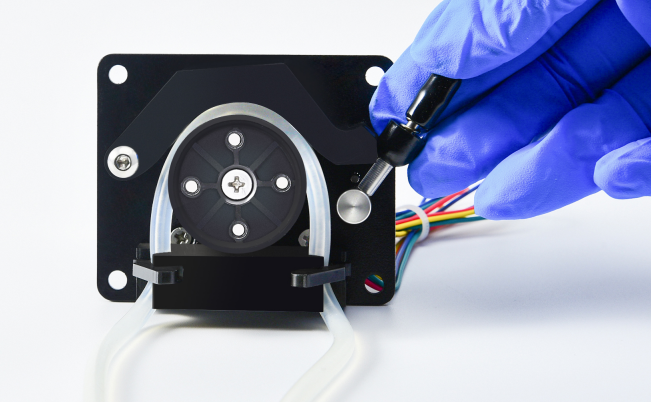
Tube internal diameter dominates: displaced volume scales with the square of the bore, so a modest ID change moves flow far more than a speed adjustment. Occlusion matters second. Under-compression allows backflow past the roller and degrades η; over-compression accelerates fatigue. As the tube work-hardens across millions of compression cycles, wall restitution slows and η drifts downward — which is why calibration intervals, not nominal specs, define real dosing accuracy over a tube's service life.
Two figures bound what the technology now delivers:
Non-occlusive head geometries achieve up to an 85% reduction in pulsation, largely removing the historical objection that peristaltic discharge was too unsteady for inline analytical instrumentation.
Industrial metering units cover 25ml/min to 65L/min, spanning microdosing and bulk transfer within one architecture.
Peristaltic vs. Diaphragm: Choosing the Right Positive Displacement Pump
Both are positive displacement technologies, and both meter reliably. The peristaltic pump vs diaphragm pump decision turns on where the fluid touches the machine.
A diaphragm pump isolates the drive mechanism behind a flexible membrane but still routes fluid through check valves, a pump chamber and manifold ports. Each of those surfaces is a wetted part requiring its own chemical compatibility assessment, and each valve seat is a potential hang-up point for slurries, fibers or crystallizing media. A peristaltic pump reduces compatibility engineering to a single question: which elastomer tolerates the fluid.
Shear is the other divide. Check valves slam shut against the stream, imposing velocity gradients that can shear long-chain polymers, damage mammalian cells or break emulsions. The rolling compression of a peristaltic head is comparatively gentle, which is why cell harvest and vaccine filling lines favor it.
Feature | Peristaltic | Diaphragm |
|---|
Wetted parts | Tube bore only | Diaphragm, valves, chamber, ports |
Maintenance task | Scheduled tube replacement | Valve and diaphragm inspection, cleaning |
Shear on product | Low; gentle rolling occlusion | Higher; valve-induced turbulence |
Diaphragm pumps retain the advantage at sustained high discharge pressures, where tube life would collapse. Where purity governs, the shorter wetted-part list usually wins on total cost of ownership, because validation effort scales with the number of contact surfaces.
Operational Resilience: Dry Running and Self-Priming Capabilities
Can peristaltic pumps run dry?
Yes — and this is one of the defining operational advantages. The question of whether peristaltic pumps can run dry has a mechanical answer: there is no seal face relying on process fluid for lubrication, and no impeller to cavitate. An empty tube simply continues to be compressed and released. The pump will not seize, gall or burn out a seal the way a centrifugal or gear pump does within seconds of losing prime. For intermittent dosing, tank strip-out and batch changeover, this converts a failure event into a non-event.
How does a peristaltic pump self-prime?
The restitution of the tube behind each roller creates the suction. Because occlusion is full, the head can evacuate air from the suction line and lift fluid from below without a foot valve or external priming system — the same action that moves liquid moves gas.
What are the limits?
Extended dry running generates frictional heat at the roller-tube interface with no fluid to carry it away. Heat softens elastomers and accelerates fatigue, so dry operation should be treated as a tolerable upset, not a duty cycle. Select tubing rated for the thermal and flex conditions involved — reinforced extrusions and thermoplastic elastomers generally outlast softer silicone under repeated dry excursions.
Industry Applications: From Pharma Purity to Water Treatment
Pharmaceutical and biotechnology. Single-use tubing sets align exactly with how modern biomanufacturing is built: the fluid path arrives sterile, is used once, and is discarded, eliminating cleaning validation for the pump entirely. Media addition, chromatography feed, cell harvest and aseptic filling all depend on a head that cannot introduce particulate from a sliding seal. Commercial performance tracks this adoption — top-tier fluid technology groups reported a statutory operating profit margin of 23.0% in 2024, a margin profile consistent with specified, hard-to-substitute equipment rather than commodity hardware.
Water and wastewater treatment. Lime slurry, ferric chloride, polymer flocculant and sodium hypochlorite share a habit of destroying conventional metering pumps — abrasives score piston bores, crystallizing chemicals weld check valves shut, and off-gassing hypochlorite causes vapor lock. The valveless peristaltic path has nothing to score and nothing to stick. Dosing accuracy holds whether the chemical is thin or loaded with settleable solids.
Food and beverage. Flavor concentrates, cultures, colorants and viscous fillings move without shear damage, and clean-in-place regimes become simpler when the only wetted surface is a smooth-bore tube with no dead legs or valve pockets to harbor biofilm.

Key Takeaways for Pump Selection in 2026
Use the following as a selection checklist when specifying a dosing or transfer head for a purity-critical or abrasive-duty application.
Isolation is the decisive criterion. If the fluid cannot tolerate contact with seals, valves or metal wetted parts — or if the process cannot tolerate particulate shed from them — the peristaltic architecture resolves the problem structurally rather than through cleaning protocol.
Pulsation is no longer a disqualifier. Non-occlusive head geometries cut discharge ripple by up to 85%, making inline sensors, coating applicators and analytical feeds practical without a dampener.
Dry-run tolerance changes the control strategy. Pumps that survive a lost prime allow tank strip-out, intermittent dosing and unattended batch endings without level-switch interlocks protecting the pump itself.
Tube selection governs long-term accuracy. Elastomer chemistry, wall thickness and reinforcement determine fatigue life, and fatigue drives the slow downward drift in delivered volume. Build a replacement schedule around measured tube life, not calendar convenience.
Match the technology to the pressure profile. Peristaltic heads excel at low-to-moderate discharge pressure. Sustained high-pressure duty still favors a diaphragm design, and specifying accordingly protects both budget and uptime.
Optimizing Your Fluid Path: The Chonry Advantage
Specification rarely ends at the catalog page. OEM designers need a head that fits an existing envelope, a drive that speaks the right control protocol, and a tubing set qualified against a particular chemistry — details that generic distribution channels are poorly placed to resolve.
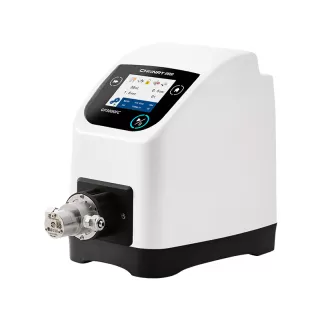
Chonry has spent 16 years building precision peristaltic pumps, and that history shows up in the parts of the product that matter to engineers: roller geometry and track tolerance that hold occlusion consistent across the tube's service life, drive electronics that translate commanded RPM into repeatable delivered volume, and head configurations designed for rapid tube changeover in production environments.
Factory-direct sourcing shortens the loop between a design requirement and a working sample. Configurations span flow rates from 1ml/min to 33L/min, covering analytical microdosing through to process-scale transfer, with head, tubing and drive options selected around the application rather than assembled from whatever a reseller stocks.
If a project carries a specific dosing tolerance, a difficult chemical compatibility constraint, or an integration requirement into a larger skid or instrument, bring the specification to the engineering team directly. Discussing tube material and occlusion settings during the design stage can prevent costly recalibration later.