1. Chemical Compatibility and Corrosion-Resistant Construction for Rare Earth Peristaltic Pumps
Rare earth separation exposes pumps to concentrated acids and aggressive organic solvents. Unlike centrifugal or diaphragm pumps, peristaltic pumps contact only the tubing with the fluid—no seals, valves, or impellers—eliminating metal-ion leaching and cross-contamination between REE streams.
Corrosion risk varies by concentration and temperature. Material selection must be explicit:
Strong mineral acids: 30-37% HCl and 68% HNO3 at <50°C rapidly degrade silicone and standard TPE, causing swelling and premature failure. PTFE-lined and high-purity FKM (fluoroelastomer) tubing offer> 1000 h service life in this range. 50-98% H2SO4 require
s PTFE — FKM is limited to <50% and <40°C due to dehydrofluorination.
Organic extractants: TBP / kerosene, D2EHPA, and Cyanex 272/572/923 swell EPDM and silicone. Recommended: PTFE for 100% TBP and Cyanex series, and chemically-resistant TPE (e.g., ChemSure®/GORE®-type) for diluted extractants <30% in aliphatic diluents. Avoid TPE with aromatic diluents.
2 . Precise Flow Control, Low-Shear Metering, and Pulsation Dampening
In rare earth SX circuits,s a stable O/A ratio is critical. Peristaltic pumps deliver repeatable metering for feed, scrubbing, stripping, and solvent regeneration because flow is a function of speed x tube ID x occlusion, not pressure, enabling ±0.5% repeatability after calibration.
Low-shear value: Unlike gear or centrifugal pumps, peristaltic compression is gentle. This prevents emulsification at the organic-aqueous interface, reduces organic entrainment loss, and preserves the activity of sensitive extractants like D2EHPA and Cyanex 272.
How to achieve precision:
1. Sizing: Select tube ID and RPM for the range. Lab-scale: 0.5-200 mL/min with 0.8- 3.2 mm ID tubing. Pilot-scale: 0.2-4 L/min with 6.4- 9.6 mm ID tubing. Always generate a calibration curve at operating viscosity — a 10 cP increase from loaded organic can shift output by 5-8%.
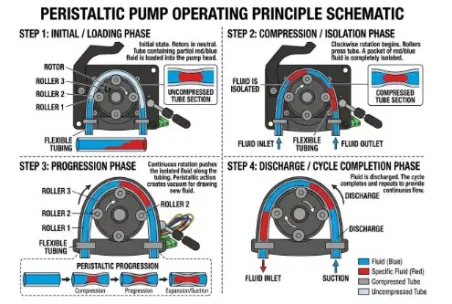
2. Pulsation control: Pulsation causes channeling in mixer-settlers. Increase roller count from 2 to 3-4 rollers to cut pulse amplitude by ∼50%. For <2% pulsation required in stripping, add an inline pulse dampener and keep discharge tubing < 1 m and straight.
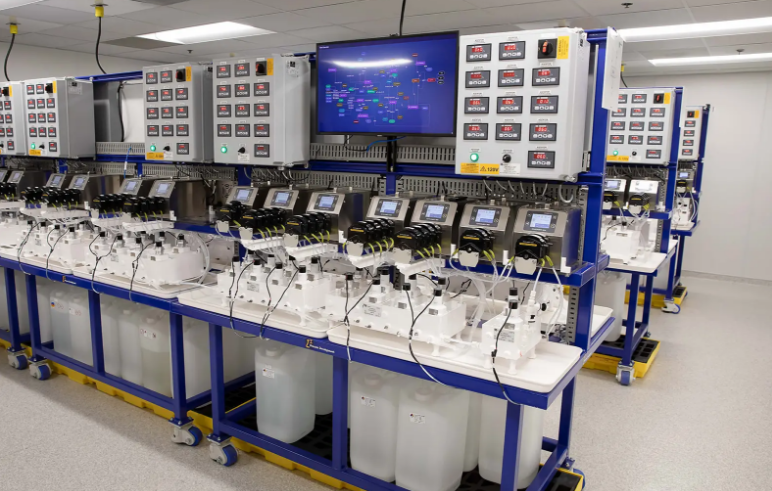
3. Multi-channel ratio: For multi-feed proportioning, use a single-drive, multi-channel head. Use tubing from the same lot, pre-condition for 30 minutes, and recalibrate each channel independently to avoid up to 3% inter-channel deviation.
3. Durable Tubing, Abrasion Tolerance, and Maintenance Planning
The only wear part in a peristaltic pump is the tubing — its life dictates OPEX in rare earth circuits. While competitors avoid this topic, field life under REE chloride slurry, high-viscosity organics >20 cP, and fine silica/fines is predictable and manageable.
Abrasion mechanisms: Chloride precipitates and undissolved REE oxalates act as micro-abrasives. Standard silicone fails in <200 hours. PTFE and reinforced fluoro-TPE resist abrasion but are sensitive to occlusion force — over-compression increases friction and reduces life by 40-60%.
Extending tubing life:
Set occlusion to the minimum that prevents backflow, typically 0.15- 0.25 mm below tube wall 2x thickness. Reduce RPM and increase tube ID for the same flow — halving RPM can double life. Use large-diameter rollers to reduce flex fatigue.
Preventive maintenance plan:
1. Inspection: Check for surface tackiness, flattening >10%, flow drop >5% vs. calibrated, or fines in the pump head — all signal end-of-life.
2. Schedule: For continuous pilot operation: PTFE 800- 1,500 h, FKM 500- 800 h, ChemSure TPE 300- 500 h with organics. Replace proactively at 80% of expected life.
3. Cost logic (US pilot): Calculate TCO as: (Tubing cost / Life hours) x 8760 + downtime cost. An $85 PTFE tube lasting1000 hh costs $0.085/h, far below a $2,500 mechanical seal failure in a centrifugal pump. Stock 1 set per channel per quarter and implement quick-load heads to keep changeover <5 min without tools.
4. Automation, Hazardous-Area Options, and Regulatory Documentation
Solvent extraction for rare earths is classified as a hazardous process in US pilot and industrial plants. Pump procurement fails not on flow, but on automation and compliance.
Hazardous-area compliance: Kerosene-based diluents, TBP, and Cyanex create Class I, Division 1 or Division 2, Groups C/D atmospheres. Specify ATEX Zone 1 / IECEx or UL Listed Class I Div 1 brushless motors with T4 temperature rating, not standard IP55 motors. Pump heads should be 316L stainless with static grounding lugs. Include leak detection sensors in the head and a secondary containment tray with solvent drain — a requirement for Process Safety Management (PSM) audits.
Automation & integration: For DOE-funded critical mineral projects, manual speed knobs are unacceptable. Require 4-20mA / 0-10V analog or Modbus RTU/TCP and PROFINET for DCS/PLC integration. Key features: remote start/stop, RPM feedback, cumulative volume logging with 21 CFR Part 11 compliant audit trails, and CIP flush ports to purge organics with nitrogen or dilute acid without disconnecting tubing.
Documentation for US approval: Beyond performance curves, prepare a compliance package: material certificates for wetted parts, FDA/USP Class VI for tubing, motor UL/ATEX certificates, mean time between failure (MTBF) data, and SOPs for tubing change-out. For NEPA and MSHA reviews, provide solvent compatibility letters and spill containment validation. This package shortens procurement review from months to weeks.
5. Ready to Scale Your Rare Earth Separation?
Choosing the right peristaltic pump is the fastest way to reduce downtime, eliminate cross-contamination, and accelerate lab-to-pilot scale-up. Don't rely on generic "corrosion-resistant" claims. Get specifics for your process.
Next steps:
Request a Flow Calculation: Share your acid system, viscosity, flow range, and stages — our engineers will return a calibrated RPM, tube ID, and tubing life estimate within 24 hours.
Evaluate Your SX Pilot: We’ll audit your existing mixer-settler or centrifugal contactor skid for pulsation, O/A drift, and hazloc compliance.
Contact our China applications team to turn chemical compatibility into continuous, auditable production.
FAQ
1: What tubing materials are compatible with hydrochloric acid and organic solvents in rare earth separation?
For 30-37% HCl, 68% HNO3, and Cyanex / TBP / D2EHPA organics, only fluoro-based tubing survives long-term. PTFE is universal for acids, including 50-98% H2SO4 and 100% extractants. FKM (fluoroelastomer) is suitable for <50% HCl/HNO3 and <40°C. Fluoro-TPE (e.g., ChemSure) works for diluted organics <30% in aliphatic kerosene. Avoid silicone, PVC, and EPDM — they swell, leach, and fail w200 hn 200h due to solvent absorption and acid attack.
2: How do you size a peristaltic pump for rare earth chloride slurry or high-viscosity strip solutions?
Size by flow at operating viscosity, not water. First, define target flow and maximum viscosity (e.g., 2 L/min at 25 cP). Then select a larger tube ID and lower RPM — halving RPM doubles tubing life in abrasive slurry. For slurries with <100 µm fines or REE chloride precipitates, use PTFE with large-diameter rollers and set occlusion to minimum sealing point to reduce abrasion. Always calibrate with actual process fluid; a 20 cP fluid can reduce flow by 5-8% versus water calibration. For pilot: 800- 1,500 h-1,500h PTFE life.
3: Can peristaltic pumps deliver accurate, low-pulsation metering in continuous rare earth separation?
Yes, when configured correctly. Peristaltic pumps achieve ±0.5% repeatability because flow is determined by occlusion, not pressure. For continuous 24/7 counter-current SX, use 3-4 roller heads to cut pulsation by 50% versus 2-roller designs, and add an inline pulse dampener for <2% pulsation required in stripping stages. For multi-stage O/A control, use a single-controller multi-channel drive with independent trimming and 4-20mA/Modbus feedback to the DCS to prevent ratio drift across 20-60 stages.