Why Peristaltic Pumps Excel in Perfume Filling
The superiority of peristaltic pumps in perfume filling is not a checklist of features, but a direct match between its working principle and the fragile nature of fragrance.
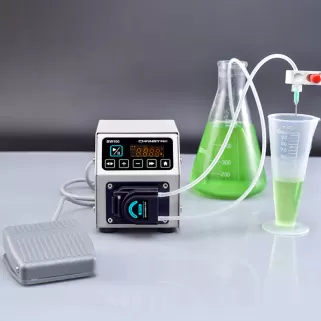
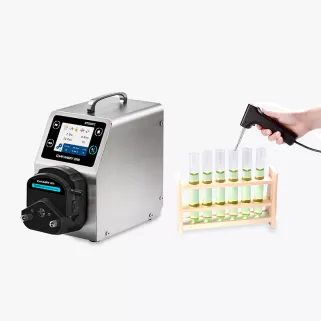
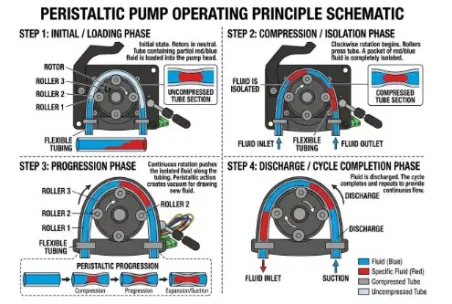
Unlike piston or gear pumps, a peristaltic pump never lets the fluid touch the pump itself. Rollers periodically compress a flexible tube, creating a sealed, moving chamber that gently pushes liquid forward. The perfume is contained entirely within the tube. This single principle solves the two most critical challenges in perfume filling: purity and integrity.
1. True Zero Cross-Contamination and Anti-Oxidation at the Source
Conventional pumps force perfume through metal cavities, piston seals, and check valves. Perfume, with its high alcohol and essential oil content, is an aggressive solvent. It leaches plasticizers from seals and picks up metal ions, which act as catalysts for oxidation — the primary cause of discoloration, off-odors, and loss of top notes during storage.
Peristaltic pumps are seal-free and valve-free. The only fluid contact material is a single, verifiable length of inert tubing, such as platinum-cured silicone or PTFE. When switching fragrances, you simply replace the disposable tube. This creates absolute physical isolation, eliminating scent carryover.
More importantly, it creates an inherently aseptic, closed filling environment. With single-use fluid paths, there is no need for complex CIP/SIP validation and no risk of microbial biofilm in hard-to-clean valves. This is critical under the U.S. FDA's 21 CFR Part 211 guidance, which increasingly emphasizes microbiological control in cosmetic manufacturing.
2. Low Shear to Protect Molecular Integrity
A perfume's scent pyramid is built from dozens of delicate terpenes, aldehydes, and macromolecules. Their spatial structure is fragile. High-shear pumps like gear pumps generate localized high temperatures and shear rates exceeding 1000 s⁻¹, which physically tears these molecules, causing the top note to flash off and the dry-down to smell flat.
Peristaltic transport is essentially laminar, with shear rates typically below 50 s⁻¹. There is no impeller chopping or high-pressure extrusion. The liquid is gently massaged forward, not cut. This gentle handling preserves the full olfactory profile intended by the perfumer and ensures consistent longevity.
3. Precision Volumetric Metering and Instant Line Changeover
Volume delivered is determined purely by geometry: tube cross-section x rotor arc length, achieving ±0.5% repeatability regardless of viscosity or micro-bubbles — essential for filling valuable 2ml to 100ml vials. And because the tube is the consumable, changeover from one SKU to another drops from 1-2 hours of cleaning to a 3-minute tube swap, enabling truly flexible, small-batch production.
Taming Perfume-Specific Challenges: Alcohol, Volatility, and Scent Integrity
Perfume is not just another liquid. It is a highly volatile, chemically aggressive solvent system. Most filling guides fail because they treat it like water. A professional guide must address three unique enemies:
1. Alcohol Attack: Solving Material Swelling and Leaching
U.S. fine fragrances typically contain 60-95% denatured ethanol. Cologne (Eau de Cologne) is at 60-70%, Eau de Toilette at 75-85%, and Eau de Parfum/Perfume at 85-95%. This high-concentration ethanol will swell and degrade standard silicone tubing within hours, causing flow rate drift, particle shedding, and seal failure.
The solution is not thicker silicone, but correct polymer chemistry. You must move up the compatibility ladder:
-For short-run, low-alcohol ( <70% ) colognes: Platinum-cured silicone may be acceptable, but requires daily replacement.
-For standard EDP/EDT (75-95% ethanol): Switch to FKM (Viton®) or ChemSure® / PharMed® BPT tubing. FKM offers excellent resistance to ethanol swelling (<3% volumetric change per ASTM D471), while Saint-Gobain's ChemSure, with its PTFE-like fluoroelastomer liner, provides near-universal chemical inertness with zero leachables. Always demand a supplier's ASTM D543 chemical resistance chart and conduct a 72-hour immersion test with your actual fragrance oil.
2. Volatility Loss: The Closed Fluid Path Advantage
Perfume top notes — citrus aldehydes, limonene, linalool — have vapor pressures 10-50 times higher than water. In an open filling system like gravity or piston fillers, VOCs escape continuously from the hopper and nozzle, leading to inconsistent scent strength and OSHA workplace exposure issues.
A peristaltic system is a fully closed fluid path from reservoir to nozzle. The fragrance is never exposed to air until it enters the bottle. This can reduce volatile organic compound (VOC) loss by over 90% compared to open-bowl systems, preserving the critical 5-15% top-note fraction and ensuring batch-to-batch olfactory consistency. Pair this with a PTFE-tipped anti-drip nozzle to prevent evaporation at the fill point.
Peristaltic vs. Piston vs. Gear Fillers: Which Fits Your Fragrance Line?
Choosing the wrong filler is the most expensive mistake for a growing fragrance brand. Here is the objective breakdown across the five dimensions that matter for perfume.
EvaluationDimension | Peristaltic Pump | Piston Pump | Gear Pump |
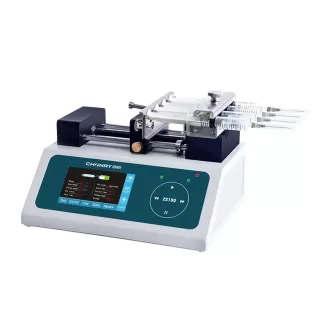
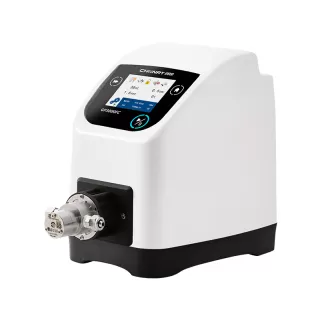
Filling Accuracy (2-100ml) | Excellent ±0.5%. True volumetric, unaffected by bubbles or viscosity. Best for 2ml vials & discovery sets. | Good ±1% at >10ml. Struggles below 5ml due to valve lag and air traps. | Moderate ±1-2%. Viscosity-dependent, not ideal for micro-doses. |
Contamination Risk | Virtually Zero. Fluid touches only the disposable tube. No seals, no valves. | High. Fluid contacts piston seals, cylinder, and check valves — leaching & cross-scent risk. | High. Fluid contacts gears and mechanical seals. Hard to clean, metal ion pickup. |
Changeover Speed | <3 Minutes. Swap tube, done. Zero cleaning validation. | 60-120 Minutes. Full disassembly, CIP/SIP, seal inspection, and odor validation. | 90+ Minutes. Complex disassembly; dead spots trap fragrance oil. |
Equipment Cost | Low to Mid. $3k-$15k per channel. | Mid to High. $8k-$25k per channel with sanitary fittings. | Mid. $5k-$20k per channel. |
Maintenance Complexity | Low. Only tubing is a wear part. No tools needed. | High. Seals, gaskets, valves are wear parts requiring skilled techs. | High. Gears wear, clearances drift, requires factory recalibration. |
The TCO Reality Check for U.S. Indie Brands
The upfront price is misleading. Total Cost of Ownership (TCO) tells the real story for American small-to-mid-size brands running 10-30 SKUs.
Let's model a 20-SKU line with daily fragrance changes:
Piston/Gear TCO: You lose 1.5 hours per changeover x 20 changes = 30 hours of downtime/month. Add $400/month in cleaning solvents, validation swabs, and $800/year in seal kits. More critically, one undetected cross-contamination event can cost a full batch — $5,000-$20,000 in perfume oil alone.
Peristaltic TCO: Tubing is the only consumable. A 1-meter ChemSure® tube ($25-$45) lasts 500-1,000 hours with ethanol-based perfumes. For our model, tubing cost is ∼$150/month. Downtime is 1 hour/month total. Payback is typically under 4 months purely on labor and scrap savings.
Bottom Line:
Choose Peristaltic if: You fill 2ml-100ml, run multiple scents, prioritize zero cross-contamination, and value flexibility over raw speed. This is 90% of U.S. indie, niche, and private-label brands.
Choose Piston if: You run a single, high-volume Eau de Toilette at >60 bottles/minute and have a dedicated CIP team. It has higher speed potential.
Avoid Gear Pumps: They offer neither the purity of peristaltic nor the high-speed precision of servo-piston for perfume. Their shear and cleaning issues make them a poor fit for fragrances.
Find Your Perfect, Contamination-Free Fill
From a 2ml discovery vial in your Brooklyn studio to a 10,000-bottle run for a California boutique brand, the right peristaltic configuration protects what matters most — your scent.
Not sure which tubing will survive your signature base?
We Provide a Free Tubing Compatibility Report
Our engineer provides one-on-one guidance from artisan workshops to mid -size brands - no hard sell, only compliance-ready solutions.
FAQ
1: How does a peristaltic pump prevent contamination during perfume filling?
It uses a seal-free, valve-free design where perfume only contacts the inside of a single disposable tube. Rollers squeeze the tube from the outside to move liquid, so there are no pistons, seals, or metal cavities that can leach, trap scent, or harbor bacteria. To prevent cross-contamination between fragrances, you simply replace the tube — creating absolute physical isolation that meets FDA Cosmetic GMP requirements for microbiological control.
2: What tubing material is best for alcohol-based perfumes like eau de parfum?
For Eau de Parfum with 85-95% SD Alcohol 40-B, do not use standard silicone. We recommend fluoroelastomer-lined tubing such as ChemSure® or Tygon® E-LFL. They show <3% swelling in ethanol per ASTM D471, resist extraction by synthetic musks like Galaxolide, and have zero plasticizer leaching. PharMed® BPT is a good mid-tier option for 500-800 hours of service, while FKM (Viton®) offers 1000+ hours for the most aggressive bases.
3: How often should I replace peristaltic pump tubing when filling fragrance oils?
With standard 75-95% alcohol perfume, replace ChemSure® / Tygon® E-LFL tubing every 800-1200 pump hours, and PharMed® BPT every 500-800 hours. For best practice, replace preventively at 80% of rated life. Replace immediately if you see failure signs: >5% OD swelling, yellowing/cloudiness, surface tackiness or cracking, or if the tube takes >2 seconds to rebound after compression.