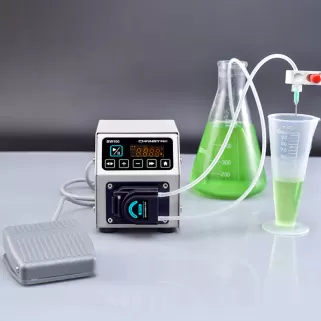
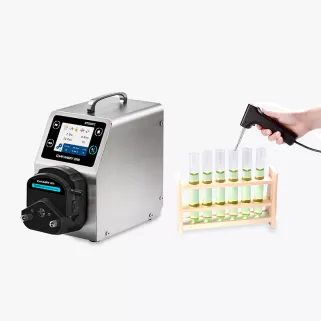
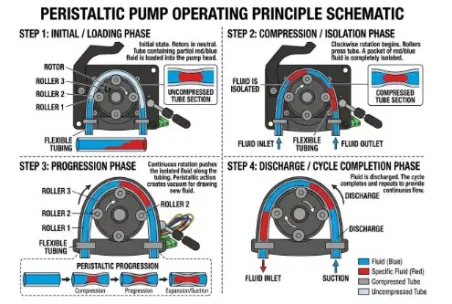
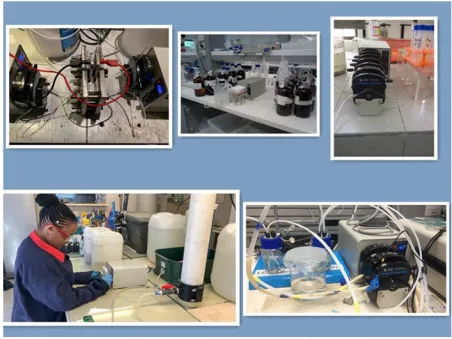
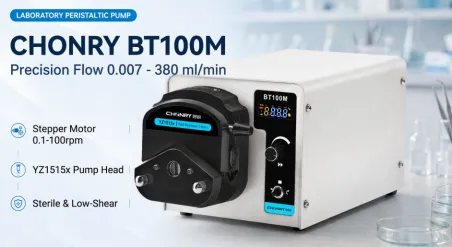
Peristaltic pumps are indispensable in protein purification, offering low-shear fluid handling, easy sterilization, and excellent chemical compatibility. However, selecting the right pump, tubing, and integration strategy requires a deep understanding of how these factors impact recovery, resolution, and reproducibility. This guide provides actionable insights across four critical areas: flow precision, tubing selection, chromatography integration, and process validation.
1. Flow Precision, Pulsation Control, and Low-Shear Handling
In protein purification, the peristaltic pump is not merely a fluid conveyor—it directly determines resolution, recovery, and process reproducibility. This section translates manufacturer specifications into practical, quantifiable targets for fraction collection and protein integrity.
Quantifying Precision: From Specs to Fractionation Windows
Manufacturers often specify flow accuracy as\ "±X%\" or \"±X% of Full Scale.\" For protein chromatography, this must be converted into a fractionation CV (Column Volume) stability metric.
Quantifiable Target: For high-resolution SEC or IEX, aim for flow stability within +/-2% of the setpoint, with pulsation amplitude (peak-to-peak) below +/-5% of the mean flow rate.
Example: At 1 mL/min with a target fraction volume of 1 mL (1 min/tube), +/-2% accuracy yields 0.98–1.02 mL/tube—acceptable for most analytical purifications. However, if the instantaneous pulsation exceeds +/-10%, cross-contamination between fractions is likely, especially with collection windows of under 30 seconds.
Pulsation Mitigation: A Multi-Pronged Strategy
Pulsation is inherent to peristaltic pumps but can be effectively managed:
• Mechanical Dampeners: Install a pulse dampener downstream to absorb 50–70% of pulsation energy. Ensure material compatibility with your protein solution and ease of cleaning.
-Long Straight Tubing Runs: Maintain a straight section of at least 50× tube ID between pump and column/collector to allow natural flow smoothing via fluid inertia and wall friction.
-Backpressure Regulator: Apply 50–100 psi backpressure post-pump to stabilize flow and suppress bubble formation. Verify that the backpressure does not exceed tubing and component pressure ratings.
-Tubing Parameter Optimization (often overlooked, highest ROI):
- Inner Diameter (ID): Use the largest ID that meets your flow requirement. For 1 mL/min, 1.6 mm ID produces significantly less pulsation than 0.8 mm ID.
- Wall Thickness: Thicker walls (e.g., 1.6 mm vs. 0.8 mm) provide better rebound elasticity and pressure stability.
- Roller Count: Pump heads with more rollers (8–10 vs. 4) produce smoother flow but increase tubing wear.
Low-Shear Operation: Protecting Fragile Proteins
For shear-sensitive proteins (antibodies, enzymes, large complexes):
- Configuration: Use the largest ID tubing at the lowest possible RPM (e.g., <50 RPM). Set the pump head occlusion to full closure to prevent tubing slippage (which generates localized heat and shear).
Example: For 10 mL/min, use 3.2 mm ID tubing at ~30 RPM.
- Bubble and Foam Reduction:
- Install a 40–100 um inline filter at the pump inlet to prevent particulate nucleation.
- Add a 10–20 cm section of gas-permeable silicone tubing before the pump head, or use a commercial online degasser.
- Pre-wet tubing with buffer before startup to avoid dry friction.
- Example Setup for mAbs: PharMed BPT tubing (3.2 mm ID), 30–50 RPM, pulse dampener + 50 psi backpressure valve, continuous pressure monitoring post-pump.
Verification Methods
Competitors list flow ranges; we provide validation methods:
- Flow Meter Method: Connect a high-precision flow meter (Coriolis or thermal mass) downstream. Record instantaneous flow over 10–30 seconds; calculate mean, standard deviation, and pulsation frequency.
- Pressure Sensor Method: Install a pressure sensor (response time <10 ms)
post-pump. Pressure waveform directly correlates with flow pulsation. Ideal waveform: smooth sine wave with no sharp spikes.
2. Tubing Selection: Materials, Chemical Compatibility, Adsorption, and Lifespan
Selecting the right tubing is critical for protein recovery, process economics, and regulatory compliance. This section provides a data-driven comparison and a practical selection framework.
Material Comparison Table
Fluoroelastomer | Viton (FKM) | Good | Low | Limited (not high-temp) | Excellent: strong acids, solvents, IPA | Long (300–500 hrs) |
Polyolefin | C-Flex | Good | Medium | Autoclave, Gamma, EtO | NaOH (1M), Peracetic Acid (1%) | Medium (100–200 hrs) |
Polyurethane | Tygon | Fair | High | Limited | Oils, weak acids/bases; not strong oxidizers | Short (50–100 hrs) |
Recommendations by Protein Type
- Monoclonal Antibodies (mAbs): PharMed BPT (first choice). Low adsorption + excellent NaOH/peracetic acid resistance for CIP cycles.
- Enzymes: PharMed BPT or Pt-cured silicone. Minimizes metal ion and leachable interference. For organic solvent workflows, consider fluoroelastomer.
- Small Proteins/Peptides: PharMed BPT (lowest adsorption risk).
- High Salt/Extreme pH: PharMed BPT (NaOH-resistant) or fluoroelastomer (acid-resistant). Silicone degrades under a strong base.
- Organic Solvents: Fluoroelastomer (FKM) is the only reliable choice.
Lifespan and Cost-Effectiveness
- Replacement Cycle Example (PharMed BPT, 1.6 mm ID, 100 RPM, moderate backpressure): Replace after ~50–80 L cumulative pumped volume or 200–300 operating hours. Silicone lasts approximately 1/3 to 1/2 of that.
- Cost Analysis: Although PharMed BPT costs 3–5× more per meter than silicone, its longer lifespan, lower failure rate, and minimal adsorption/leachables risk make it more cost-effective for critical steps when total cost of ownership (TCO) is considered.
Selection Workflow, Testing, and Replacement Thresholds
Selection Steps:
1. Define chemical compatibility: List all process fluids (buffers, cleaning agents, samples) and concentrations.
2. Assess adsorption risk: Check manufacturer data (e.g., <1 µg/cm²). If unavailable, perform a static adsorption test: soak the tubing in a 1 mg/mL protein solution for 24 hrs and measure the concentration change.
3. Match sterilization method: Confirm the material can withstand your process (e.g., 121°C autoclaving).
4. Estimate lifespan: Use the table above as a starting point; adjust based on your RPM and backpressure.
Testing Method: Dynamic adsorption test—pump protein solution under simulated process conditions, collect effluent, measure recovery via UV280 or ELISA. If recovery <95%, adsorption is significant.
Replacement Thresholds:
- Visual: Cracks, discoloration, permanent deformation, or rough inner surface.
- Performance: Flow rate deviation >±5% from initial, or steadily increasing post-pump pressure (indicating inner wall collapse).
- Time-based: Replace at the preset interval (e.g., 300 hrs) even if visually intact.
3. Chromatography Integration, Fraction Synchronization, and Pump Comparisons
Integrating a peristaltic pump into a chromatography system requires careful consideration of interfaces, synchronization signals, and pump type selection. This section provides a practical roadmap.
Connection Points
- Sample Loading: Connect the pump outlet to the AKTA Sample Inlet or Injection Valve. This is the most common application, providing stable, low-shear sample delivery.
- Recirculation: Use the pump to circulate buffer from a reservoir through the system, or to recirculate column effluent for regeneration/equilibration.
- Post-Column Delivery: Add labeling reagents, adjust pH, or perform online dilution by connecting the pump between the column outlet and detector/fraction collector.
Synchronization Strategies
- Digital I/O: Connect the pump TTL input/output to the ÄKTA's fraction collection output. Example: ÄKTA's "Fraction Collection Start" signal triggers pump start/stop.
- Analog Control: ÄKTA outputs 0–10 V or 4–20 mA to control pump speed in real time.
- Software Trigger: Use UNICORN event outputs to control pump start/stop and speed changes.
- Precise Fraction Synchronization:
- Flow Sensor: Place a high-precision flow meter between the pump and the fraction collector. The collector uses cumulative volume to trigger tube changes, compensating for pulsation errors.
- Optical/Drop Trigger: Install a bubble sensor or drop counter post-pump. Each drop triggers a tube change—highly accurate at low flow rates (<1 mL/min).
- Delay Compensation: Account for tubing volume between the pump and the collector. Example: 2 mL of tubing volume at 1 mL/min = a 2-minute delay before the tube change.
Pump Type Comparison for Chromatography
Feature | Peristaltic | Reciprocating/Piston | Diaphragm |
|
|
Flow Stability | Good (with dampening) | Excellent (pulse-free) | Good |
|
|
Pulsation | Moderate (suppressible) | None | Low–Moderate |
|
|
Shear | Low | High (risks proteins) | Moderate |
|
|
Maintenance | Simple (replace tubing) | Complex (seals, check valves) | Moderate (diaphragm) |
|
|
Sterilization | Excellent (single-use path) | Difficult | Good (some SIP-capable) |
|
|
Automation and Remote Monitoring
- Communication Protocols: Modern peristaltic pumps support Modbus RTU/TCP, EtherNet/IP, and Profibus for seamless DCS/SCADA integration.
- Analog I/O: 0–10 V or 4–20 mA input (speed control) and output (actual speed/flow feedback).
- Common Issue: False fraction triggers from pulsation.
- Hardware Fix: Install a pulse dampener upstream of the flow sensor.
- Software Fix: Set signal filtering or a deadband in the fraction collector software to ignore sub-threshold pulses.
Calibration Procedure
1. Install new tubing; flush with DI water.
2. Set the pump to the target RPM (e.g., 50 RPM).
3. Pump into a graduated cylinder; start timer.
4. Collect for 1 minute; measure volume; calculate actual flow rate.
5. Adjust pump calibration factor (usually in the pump menu) to match the display to the actual value.
6. Repeat until deviation is <±1%.
4. Sterility, CIP/SIP, Scale-Up, Validation, and Troubleshooting
This section provides executable strategies for maintaining sterility, scaling up, validating performance, and troubleshooting common issues in protein purification workflows.
Sterility and CIP/SIP Strategies
Material Tolerance:
- CIP: PharMed BPT and Pt-cured silicone withstand 0.5–1 M NaOH, 1% peracetic acid, and 70% IPA.
- SIP: Pt-cured silicone tolerates repeated 121°C steam cycles. PharMed BPT also tolerates SIP; check manufacturer cycle limits (typically >50 cycles).
Flow Path Design:
- Single-Use: Pre-sterilized, disposable tubing sets—ideal for early-stage development to avoid cross-contamination.
- Reusable: Design modular flow paths with sterile connectors (e.g., AseptiQuik, Luer-Lock) for CIP/SIP.
- Sterile Filtration: Install a 0.2 um sterilizing filter post-pump. Note: filter adds backpressure; ensure the pump can overcome it.
When to Use: CIP/SIP or single-use is mandatory for GMP production or strict bioburden control. For analytical purification, periodic tubing replacement and flow path cleaning suffice.
Scale-Up Considerations
Flow and Pressure: Scaling from lab (<10 mL/min) to pilot (100–1000 mL/min) to production (>1 L/min):
- Use larger pump heads (multi-channel or high-flow) to accommodate larger ID tubing.
- System backpressure increases significantly with flow. Ensure the pump and tubing maximum working pressure covers the scaled-up requirement (e.g., from <1 bar to 2–3 bar).
Maintaining Recovery:
- Keep linear velocity (cm/h) constant, not volumetric flow rate.
- Use the same tubing material with a larger ID to avoid changes in adsorption characteristics.
- Re-evaluate pulsation—larger systems often have higher backpressure, requiring more robust dampening.
Validation and Performance Data Examples
- Recovery Validation: Pump a known protein standard (e.g., BSA) under scaled conditions; measure effluent via UV280 or BCA assay. Target: >98% recovery.
- Dialysis Loss: For dialysis or ultrafiltration, measure target protein concentration in the permeate. Target: <1% loss.
- Residual Cleaning Agent Quantification: After CIP, rinse with purified water and measure conductivity or TOC. Target: <1 µS/cm conductivity, <50 ppb TOC.
Troubleshooting Checklist
Symptom | Possible Cause | Detection Steps | Remedy |
Flow rate drop | Tubing老化/inner wall collapse; inlet blockage; insufficient occlusion | Inspect tubing; clean inlet filter; re-adjust occlusion | Replace tubing; clean filter; adjust pressure plate |
Tubing slippage/rupture | Excessive occlusion; high backpressure; wrong ID | Check pressure plate; measure backpressure; verify ID | Adjust occlusion; reduce backpressure; use correct tubing |
Leakage | Loose fittings, cracked tubing, improper pump head installation | Inspect all fittings; check tubing; re-install tubing | Tighten fittings; replace tubing; re-install correctly |
Recovery decline | Increased protein adsorption; incompatible material; sample degradation | Run dynamic adsorption test; check pH/salt; assess shear | Switch to low-adsorption tubing; optimize buffer; reduce RPM |
Air bubbles | Low inlet level; loose connections; non-degassed solution | Check reservoir level; inspect connections; degas buffer | Refill, tighten connections, and use a degasser |
Next Steps: Turn Knowledge into Action
Ready to apply these insights to your protein purification workflow? Here's how we can help:
1. Download Resources: Get our Peristaltic Pump & Tubing Selection Checklist and CIP/SOP Templates for protein workflows.
2. Schedule a demo: Witness firsthand how our pumps are actually running on the proteins you're interested in. Our application engineers will provide a live demonstration.
3. Request Performance Testing: Send us your sample and method. We'll perform flow and recovery testing in our lab and provide a detailed report.
4. Use Our Online Selector Tool: Enter your target flow rate, protein type, and cleaning protocol—get instant tubing and pump model recommendations.
5. Contact Technical Support: Our team is ready to provide verifiable case studies and maintenance plan templates to support your procurement and validation process.
Frequently Asked Questions
How do I choose the best tubing material for minimizing protein adsorption and leachables?
PharMed BPT is the gold standard, with protein binding typically <1 µg/cm² and very low extractables. Platinum-cured silicone is a good, economical alternative for less demanding applications. Avoid Tygon and PVC, which have higher adsorption and leachables.
What pump settings and accessories reduce shear and foaming when pumping fragile proteins?
Use the largest ID tubing at the lowest possible RPM. Set occlusion to full closure. Install an inlet filter (40–100 um), an online degasser or gas-permeable silicone section, and a pulse dampener with a backpressure regulator (50–100 psi).
Q: How can I synchronize a peristaltic pump with an ÄKTA or fraction collector to ensure accurate fractions?
A: Use digital I/O (TTL start/stop), analog control (0–10 V speed control), or flow sensor feedback (cumulative volume triggers tube changes). Always calculate and apply delay compensation for tubing volume.
Q: Which CIP/SIP chemistries and sterilization methods are compatible with common peristaltic tubing?
A: PharMed BPT and Pt-cured silicone tolerate 0.5–1 M NaOH, 1% peracetic acid, and 70% IPA for CIP. Pt-cured silicone is excellent for repeated 121°C SIP. Both are compatible with gamma/E-beam sterilization.
Q: How do I scale a peristaltic pump setup from lab to pilot production without losing protein recovery?
A: Maintain constant linear velocity (cm/h). Use the same tubing material with a larger ID. Re-evaluate pulsation dampening for higher backpressure. Validate recovery (>98%) after scaling.
Q: When should I use a peristaltic pump versus a piston or diaphragm pump for chromatography applications?
A: Choose peristaltic for shear-sensitive proteins, easy sterilization (disposable path), self-priming needs, or viscous/particulate feeds. Choose a piston for ultra-low pulsation and high pressure (HPLC/UHPLC). Choose a diaphragm for seal-less chemical handling at scale.