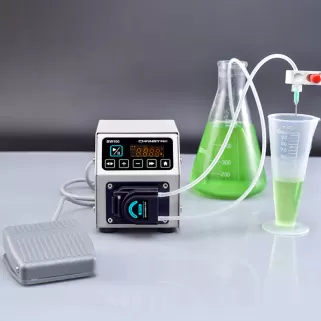
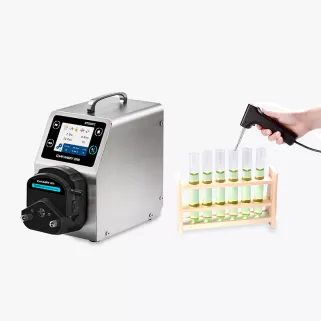
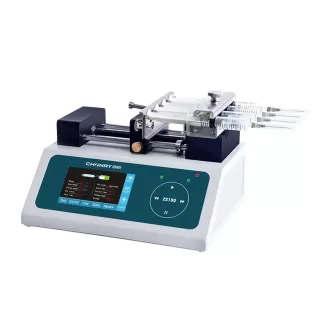
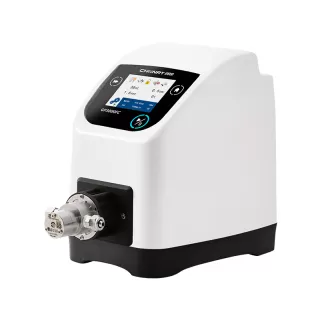
Let's be honest: most peristaltic pump spec sheets are useless. They'll tell you a peristaltic pump can do "0.001 to 3000 mL/min." That's like saying a car can go from 0 to 200 mph. Technically true. Practically, you'd never drive your minivan on a racetrack.
Choosing the right lab peristaltic pump isn't about finding the one with the best numbers. It's about matching the pump's mechanical personality to your liquid's specific needs. Here's how to do it without getting lost in the marketing noise.
Step 1: Find Your Flow Zone
Forget the full range. Find your sweet spot. Your application lives in one of four zones:
Application Zone | Typical Flow Rate | RPM Range | Tubing ID | Drive Type |
Micro-Dosing & Titration | 0.001 – 1 mL/min | 0.1 – 50 RPM | 0.13 – 0.89 mm | Stepper motor |
Precise Feed & Drug Delivery | 0.1 – 50 mL/min | 1 – 200 RPM | 0.89 – 3.17 mm | Stepper or DC servo |
General Transfer & Filtration | 10 – 500 mL/min | 10 – 600 RPM | 3.17 – 8.0 mm | Standard DC motor |
High-Volume Bulk Transfer | 500 – 3000+ mL/min | 100 – 600 RPM | 8.0 – 19.0 mm | High-torque DC motor |
The Golden Rule: Never run a peristaltic pump at its max RPM for continuous duty. You'll cook the tubing and burn out the motor. Always leave 20-30% headroom.
Step 2: Understand the Real Precision (Not the Marketing Precision)
Every vendor brags about "±1% accuracy." That's a lie they tell at trade shows. Here's the truth:
Accuracy is how close you get to the target (you want 10 mL, you get 9.8 mL).
Precision (Repeatability) is how consistent you are (you get 9.8 mL, 9.8 mL, 9.8 mL).
For 90% of lab work, precision is king. You can always calibrate for accuracy. You can't fix an inconsistent pump.
What actually kills your precision?
· Tubing Fatigue. This is the #1 killer. Every time the roller compresses the tubing, it damages it slightly. After 100 hours, the tubing wall is thinner, the internal volume is smaller, and your flow rate drifts. A new tube gives 10.0 mL. An old tube gives 9.2 mL. Same RPM.
· Motor Jitter. Cheap DC motors with analog speed controllers drift. A lot. A stepper motor locks onto its speed with zero drift. That's why it costs more.
· Back Pressure. Pumping into a filter or a narrow column changes the tubing shape. Peristaltic pumps are low-pressure devices (< 2 bar). Push them harder, and your flow rate drops.
The real-world precision table:
Pump Head Type | Typical Precision | Best For |
Standard Roller (2-4 rollers) | ±2% – ±5% | General transfer, waste removal |
Multi-Roller (6-12 rollers) | ±0.5% – ±2% | Dosing, bioreactor feed |
Spring-Loaded / "Click" | ±1% – ±3% | High-pressure, viscous fluids |
Peristaltic + Stepper Motor | ±0.1% – ±1% | Micro-dosing, chromatography |
Step 3: Pick Your Head Type (This Matters More Than You Think)
The pump head is where the rubber meets the road. Literally.
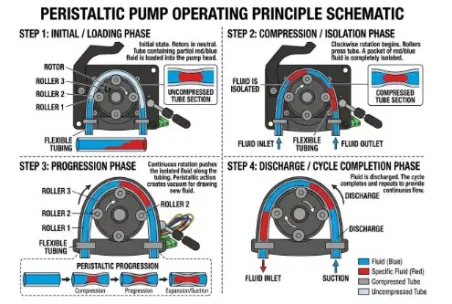
· Standard Roller Head: The workhorse. Cheap, simple, easy to change tubing. High pulsation. Great for "dump this buffer into that tank."
· Multi-Roller / Low Pulsation Head: More rollers = smoother flow. Essential for bioreactor feed where a steady stream prevents pH spikes. The trade-off? More tubing wear.
· Spring-Loaded ("Click") Head: The tubing is compressed by a spring, not a fixed gap. This gives you higher pressure (up to 8 bar) and longer tubing life. Perfect for filtration or pumping viscous media.
Real-World Examples (Because Theory is Boring)
Example 1: The Titration (Micro-Dosing)
Problem: You need to add 0.5 mL of a catalyst dropwise over 10 minutes.
Solution: A micro-peristaltic pump with a 0.5 mm ID tubing and a stepper motor.
The Math:
• Target: 0.5 mL / 10 min = 0.05 mL/min
• Tubing Factor: Your pump head datasheet says 0.01 mL/rev for this tubing.
• RPM = 0.05 / 0.01 = 5 RPM
Set it to 5 RPM. Done. No calibration needed if the tubing is new.
Example 2: The Bioreactor Feed (Precision)
Problem: Feeding glucose at 2 mL/hour. A standard pump pulses, causing local high-glucose zones that stress your cells.
Solution: A 6-roller pump head. More pulses per minute = smoother flow. The trade-off is more tubing wear, but for a critical fed-batch process, that's a small price to pay.
Example 3: The Auto-Sampler (Accuracy)
Problem: Your HPLC autosampler needs to pull exactly 20 µL.
Solution: A spring-loaded head. Why? Because the spring maintains constant compression as the tubing ages. This gives you stable flow over the lifetime of the tubing.
Pro Tip: For anything requiring better than ±2%, do a gravimetric calibration. Pump water into a beaker on a balance for 1 minute. Weigh it. Adjust your RPM. Repeat. This accounts for your specific tubing batch and back pressure.
Your Decision Tree
Ask yourself these three questions:
1. What's my flow rate?
< 1 mL/min → Micro-dosing path (stepper motor, thin tubing)
1 – 100 mL/min → Precision path
> 100 mL/min → Bulk transfer path (standard motor, thick tubing)
2. How critical is precision?
Critical (cell feed, drug dosing) → Stepper motor + multi-roller head ($$$)
Important (fraction collection) → DC servo + standard head ($$)
Not critical (media transfer) → Standard DC motor ($)
3. What's my back pressure?
Low (< 1 bar) → Any head works
Medium (1-3 bar) → Spring-loaded head
High (> 3 bar) → Don't use a peristaltic pump. Get a piston pump.
Budget vs. Performance: The Honest Breakdown
Feature | Budget ($) | Mid-Range ($$) | High-End ($$$) |
Motor | DC, analog control | DC servo, encoder | Stepper, closed-loop |
Head Type | 2-roller, fixed | 4-roller, fixed | 6-12 roller or spring-loaded |
Tubing Life | 200-500 hrs | 500-1000 hrs | 1000-3000 hrs |
Precision | ±5% | ±2% | ±0.5% |
Pulsation | High | Medium | Low |
Best For | Media prep, waste | Filtration, dosing | Cell culture, micro-dosing |
Price Range | $200 - $800 | $800 - $2,500 | $2,500 - $8,000+ |
The Bottom Line
Don't buy a Ferrari to drive to the grocery store. A $300 Lab peristaltic pump with a standard head is perfect for moving 10L of PBS. But if you're feeding a $10,000 bioreactor run, the $3,000 pump is the cheapest insurance you can buy.
Know your flow zone. Respect tubing fatigue. And never trust a spec sheet that promises ±1% without telling you the conditions.