How Peristaltic Pumps Work for Colorant Dispensing
The principle is as simple as squeezing toothpaste.
Inside a peristaltic pump, there is only one flexible tube and a rotor with several rollers. As the motor turns, the rollers sequentially compress the tube. This compression creates a sealed pillow of fluid that is pushed from the inlet to the outlet. Throughout the entire process, the colorant only touches the inside of the tube — never the pump housing or rollers.
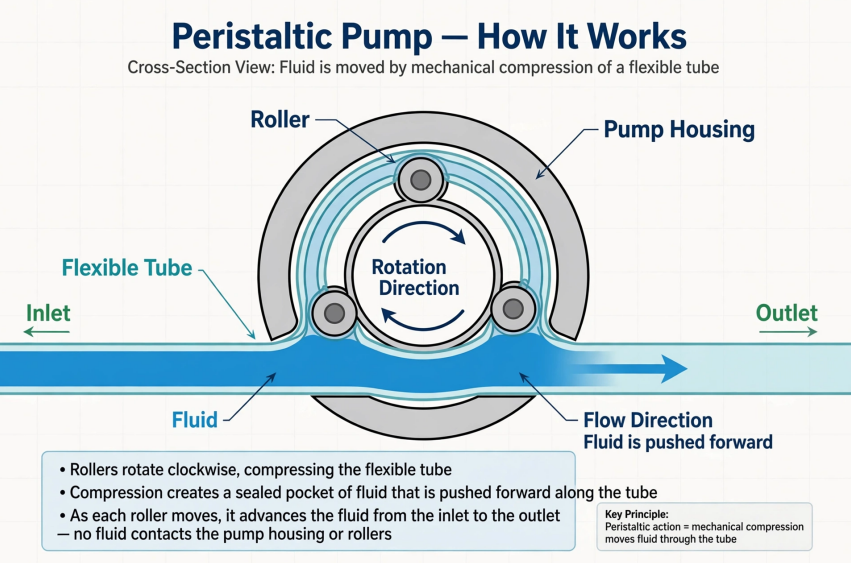
This simple squeezing action makes it naturally perfect for colorants, solving three critical problems that gear and piston pumps can't handle:
1. Valveless Design = No Clogging
Colorants are high-viscosity, prone to settling, and often contain pigment particles. Traditional pumps with valves and narrow channels easily clog and cake. A peristaltic pump has just one straight tube path. No valves, no dead zones. Particles pass through freely, and even if colorant dries during downtime, you simply replace the tube — no disassembly or cleaning of the pump.
2. Low Shear = True Color Fidelity
Color accuracy depends on intact pigment dispersion. High-shear pumps crush and break down pigment particles, causing color shift, floating, and flooding. Peristaltic action is a gentle, low-shear push, not a cut or grind. It preserves the rheology and dispersion structure of the paste, ensuring batch-to-batch color consistency.
3. Reversible Suction = Zero Drip
In dispensing, accuracy down to 0.01ml matters, and a single drip at the nozzle means waste and contamination. Peristaltic pumps can instantly reverse, creating a slight suck-back that pulls the residual droplet back into the tube. This eliminates stringing, dripping, and cross-contamination between colors. Changing colors is as simple as changing the tube.
While competitors just categorize pumps by type, they miss the point: for colorant dispensing, peristaltic technology isn't just an option — it's the solution engineered for the material itself.
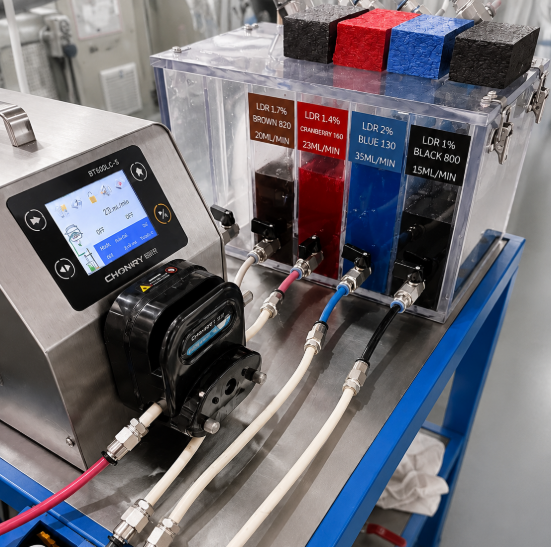
Precision, Flow Control, and Color Consistency in Metering
In colorant dispensing, precision isn't just about flow rate — it's about repeatable ΔE (color difference) control. Competitors often equate flow control with "adjust the motor speed," but for colorants, that misses two critical failure points: pulsation and sedimentation.
1. From Pulsating Flow to Smooth Dosing
A standard 2- or 3-roller peristaltic pump creates inherent pulsation. Each time a roller disengages, flow momentarily drops. For water,r this is invisible, but for colorants, pulsation causes uneven tinting and visible streaks in the base paint.
High-precision dispensing solves this at two levels:
a) Motor Control: We use stepper or brushless DC servo motors with micro-stepping control, not simple DC motors. This allows speed regulation down to 0.1 RPM and precise angular positioning. Instead of a constant speed, the motor dynamically accelerates in the "pulsation gap" to compensate for the flow dip, delivering a near-linear volume per revolution. Each revolution equals a calibrated volume.
b) Multi-Roller & Offset Head Design: Increasing to 6, 8, or even 10 rollers significantly reduces the volume of each fluid pillow and increases pulse frequency, making flow overlap smoother. For multi-channel tinting machines, offset rotor heads (e.g., two channels 30° out of phase) can cancel each other's pulsation, achieving truly continuous blending for proportional color matching.
2. Eliminating Metering Error from Sedimentation
Colorant is a suspension, not a solution. When a pump sits idle, pigments settle in the tube, causing the first shot to be too light and the next too dark.
A peristaltic system addresses this with programmed anti-settling routines: a slow, intermittent forward-backward jog keeps particles in suspension without dispensing. Because the tube is fully sealed, there is no valve to trap settled particles, ensuring the first and 100th dose have the same solid content.
3. Low-Shear Ratio Control
Maintaining pigment dispersion is key to consistency. Our low-shear extrusion preserves the dispersant layer around each pigment particle, preventing flocculation that would shift the color.
Precise color ratioing is then achieved through two independent variables:
Tube ID Selection: Coarse and fine dosing use different bore sizes. Large ID (e.g., 6.0mm) for fast base fill, small ID (e.g., 1.6mm) for micro-dosing of expensive tinters.
Speed Fine-Tuning: Within a single channel, flow is linear to speed ( Q = k × n ). With servo control, we can achieve ±0.5% repeatability accuracy, allowing formulation software to convert a Lab* value directly into RPM × time for perfect, repeatable shades every time.
Integrating Peristaltic Pumps into Automated Colorant Dosing Systems
A pump is only as good as the system it lives in. For automated tinting, the real challenge is not pumping — it's integration with PLC, MES, and color management software. This is where most competitors stop at a 4-20mA signal, while peristaltic technology offers a system-level advantage.
1. Seamless Integration with Color Management Systems
Modern automated dosing is driven by formulation software (e.g., Datacolor, X-Rite). The software converts a target color into a recipe: 12.35ml of Red Oxide, 2.08ml of Carbon Black.
Peristaltic pumps are natively digital dosing devices. Each roller pulse = a fixed volume, so the PLC can translate software commands directly into pulses or stepper steps, not just timed flow. Via RS485 / Modbus / CANbus, the system achieves closed-loop control:
Formula Software -> PLC -> Pulse count -> Actual volume feedback
No calibration curve for viscosity or pressure is needed, unlike gear pumps where flow changes with viscosity. This enables true "first-shot accuracy" for small-batch custom colors, from 50ml lab samples to 20L industrial batches.
2. Self-Priming Simplifies Layout and Eliminates Bubbles
Colorant containers are often placed below the dosing head for safety and space. Peristaltic pumps offer 8- 9 m self-priming capability with dry-run tolerance.
This means:
Flexible layout: No need for gravity feeding or flooded inlets. Tubes can run directly from the original pail on the floor to the dispensing nozzle.
Bubble-free dosing: Unlike gear pumps that cavitate and trap air when sucking, peristaltic suction is gentle and continuous. No cavitation means no micro-bubbles, which are a major cause of pinholes and color deviation in inks and automotive coatings.
3. Built for Coatings & Inks: Explosion-Proof and Clean
The coatings industry requires ATEX / Ex d compliance. In a peristaltic pump, the fluid is completely isolated inside the tube. The drive unit can be a certified explosion-proof motor with no dynamic seals and no mechanical seal leakage path. The colorant itself never generates friction heat in a sealed chamber.
Peristaltic vs. Gear Pump in Colorant Service
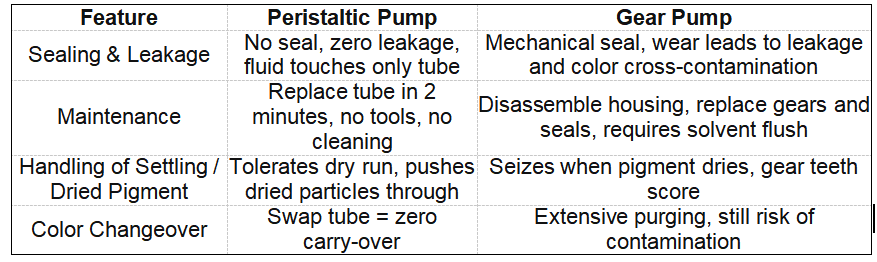
In short, integrating peristaltic pumps means fewer auxiliary components — no feed pumps, no seal flush, no air purge — and a simpler, compliant, and truly automated dosing station that software can trust.
Ready to Eliminate Color Inconsistency?
If clogging, dripping, and batch-to-batch color shifts are costing you time and material, it's time to switch to a pump designed for colorants — not adapted from general industry.
Our engineering team based in China provides application-specific selection — from tube material compatibility to pulse-free multi-channel heads — with rapid prototyping and fast domestic shipping.
Take the next step:
1. Get Your Custom Selection: Contact our fluid experts for a free assessment of your viscosity, pigment load, and dosing accuracy needs.
2. Download the Guide: Get our free white paper,r The Definitive Guide to Peristaltic Pump Selection for Colorant Dispensing — including tube life charts and chemical compatibility tables.
3. Book a Free Dosing Test: Send us your most difficult colorant; we’ll run a video-documented precision test in our lab at no cost.
[Explore Colorant Dispensing Pumps] | [Request a Quote & Free Test]
Let's solve your specific dispensing challenge — with accuracy you can see in every shade.
FAQ: Peristaltic Pumps for Colorant Dispensing
1: What tubing materials are compatible with solvent-based paint colorants?
Solvent-based colorants are aggressive and will swell standard silicone tubing. For these applications, we recommend:
Viton® (FKM) / Fluran® F-5500-A: Excellent resistance to ketones, esters, and aromatic hydrocarbons. The industry standard for solvent-borne coatings and inks.
Chem-Sure® (ePTFE composite): For extreme solvents like MEK, toluene, and xylene where elastomers fail. Near-universal chemical resistance.
Avoid: Standard silicone, PVC, and Tygon® E-Lab — they will swell, leach plasticizer, and contaminate color.
Always provide your full solvent formulation for a 72-hour soak test — compatibility is based on concentration and temperature.
2: How do peristaltic pumps prevent pigment settling and agglomeration during dispensing?
Through three mechanisms: First, no dead zones — the fluid path is a single continuous tube, so there are no valve cavities where pigment can settle. Second, programmable anti-settling jog — the PLC can trigger a slow 1-2 second forward-reverse rotation every few minutes to keep the suspension moving without dispensing. Third, low-shear pumping — unlike gear pumps that crush particles, peristaltic rollers gently massage the tube, preserving the dispersant layer and preventing shear-induced flocculation.
3: Can peristaltic pumps achieve high repeatability for small-batch colorant metering?
Yes — this is their core strength. With a servo/stepper motor and small-bore tubing (e.g., 1.6mm ID), we achieve ±0.5% repeatability and dosing as low as 0.05ml. Because flow is volumetrically locked to rotor position (not pressure-dependent like gear pumps), viscosity changes don't affect accuracy. This is ideal for automotive refinish, lab color matching, and inkjet ink formulation where batches can be under 100ml.
4: What is the typical pulsation level and how does it affect color uniformity?
A standard 3-roller head has ∼15-20% pulsation, which can cause visible tint streaks. For color-critical applications, we reduce this to <3% through:
1. Multi-roller design (6-10 rollers) to create smaller, overlapping fluid packets.
2. Pulsation compensation algorithms — the motor briefly accelerates when a roller disengages to fill the flow gap.
The result is a visually continuous stream, ensuring the colorant blends instantly and uniformly into the base, with no light/dark bands in the final coating.




![Best Peristaltic Pump for Water Treatment Chemical Dosing [2026 Guide]](/data/watermark/20260902/6a97edf4bde65452_361.webp "Best Peristaltic Pump for Water Treatment Chemical Dosing [2026 Guide]")