In laboratories and production facilities across life sciences, pharmaceuticals, and specialty chemicals, the accurate and consistent handling of sensitive fluids is not merely an operational step—it is the foundational
pillar of product integrity, experimental validity, and regulatory compliance. The task of medium dispensing—transferring culture media, reagents, buffers, or bioactive solutions—presents a unique set of challenges:
preserving sterility, maintaining fluid integrity, ensuring volumetric precision, and facilitating seamless cleaning or disposal. Within this demanding landscape, peristaltic pump technology has emerged as a preferred
and robust solution, its operational principle offering distinct advantages for critical dispensing applications.
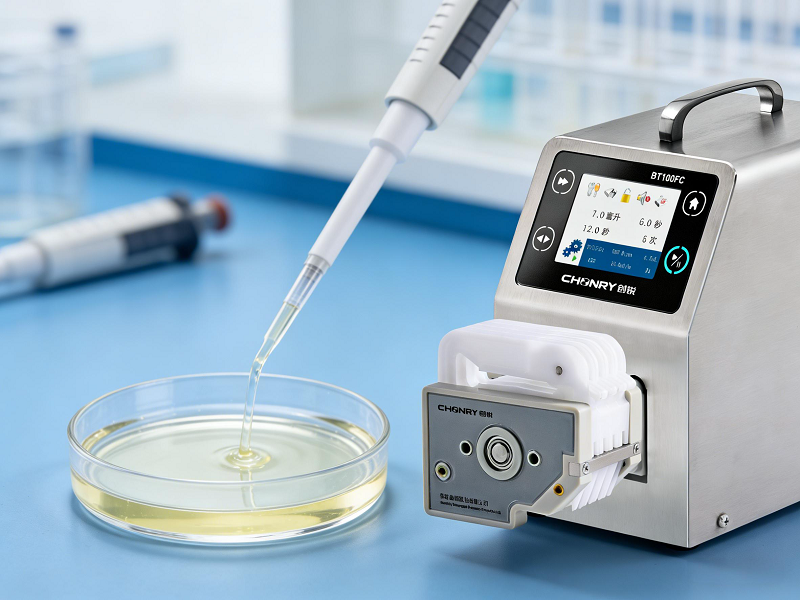
The Core Principle: Isolated, Contamination-Free Flow
At its heart, a peristaltic pump operates on a simple yet profoundly effective mechanism. Fluid is contained entirely within a flexible tube, which is compressed against a housing by rotating rollers or shoes attached to
a rotor. This compression creates a temporary seal that moves along the tube, propelling the fluid forward. The subsequent recovery of the tube’s shape generates a powerful, gentle suction that draws more fluid in,
creating a consistent, pulsating flow. The defining characteristic is that the fluid contacts only the interior of the tube. There are no seals, valves, or internal pump cavities that come into contact with the medium,
eliminating a major vector for contamination, cross-contact, and difficult cleaning procedures. This makes the peristaltic pump uniquely suited for sterile and aseptic processing, as the fluid pathway can be easily
sterilized or configured as a single-use, disposable assembly.
Anatomy of a Precision Dispensing System
A peristaltic pump engineered for medium dispensing is a study in precision engineering, with each component contributing to its performance.
Pump Head & Drive: The pump head houses the rotor mechanism. For dispensing, designs often emphasize accurate occlusion (the consistent sealing of the tube) and gentle action to minimize pulsation and extend
tubing life. The drive provides controlled rotation, with stepper or servo motors enabling highly precise incremental dosing. Modern drives integrate digital controls for flow rate, volume dispensed, and rotation direction.
Tubing: The Critical Wear Component: The tubing is the pump’s functional heart. Material selection is paramount and depends entirely on the medium being dispensed. For general laboratory use, platinum-cured silicone
is common for its flexibility, biocompatibility, and clarity. For aggressive solvents or chemicals, fluoropolymer-based tubes like Teflon® may be specified. In bioprocessing, USP Class VI-certified silicone or C-Flex® is standard.
Tube inner diameter and wall thickness directly determine flow rate and pressure capability.
Manufacturing & Integration: High-quality pumps feature machined or molded pump heads with tight tolerances to ensure consistent tube occlusion. Drives are assembled with precision gears and feedback systems.
The trend is towards modular systems where pump heads can be swapped for different tube sizes or configured in multi-channel arrays for parallel dispensing into microplates or bioreactor arrays. Integration with bottle
level sensors, pinch valves, and supervisory control systems is common in automated workcells.
Key Factors Influencing Performance and Reliability
Selecting and operating a peristaltic pump for medium dispensing requires careful consideration of several interdependent factors:
Fluid Compatibility: The chemical and temperature compatibility between the medium and the tube material is non-negotiable. Swelling, leaching, or degradation of the tube can compromise both the medium and the
pump’s accuracy.
Occlusion Setting: The precise adjustment of the compression on the tube is critical. Insufficient occlusion causes backflow and inaccuracy; excessive compression accelerates tube wear and can damage shear-sensitive
fluids like cell cultures.
Tubing Fatigue and Lifecycle: The repeated compression-relaxation cycle is the primary wear mechanism. Predicting and scheduling tube changes based on operating hours, fluid type, and pressure is essential to prevent
unexpected failure and maintain dispensing accuracy.
Flow Rate Accuracy and Precision: This is determined by the drive’s control resolution, the consistency of tube rebound, and system backpressure. For critical applications, calibration against the actual fluid is often
necessary.
Addressing Industry Pain Points and Common Questions
The adoption of peristaltic pumps directly addresses several persistent industry challenges:
Maintaining Sterility: In vaccine or monoclonal antibody production, single-use tubing paths eliminate cleaning validation and the risk of batch-to-batch contamination.




![Best Peristaltic Pump for Water Treatment Chemical Dosing [2026 Guide]](/data/watermark/20260902/6a97edf4bde65452_361.webp "Best Peristaltic Pump for Water Treatment Chemical Dosing [2026 Guide]")