In the lab, some tasks are extremely reliant on "feel." For example, it might require spending two hours, holding a syringe, intently and at a constant rate, dripping 5 milliliters of a crucial liquid.
A slight delay or speed could ruin an entire day's experiment.

Dr. Wang's team was once stuck in this stage. They were synthesizing nanoparticles for targeted drug delivery, and the secret to success lay in "uniformity." Manually adding catalysts meant that
even the slightest mistake would result in inconsistent particle sizes. Different people would produce different results; even the same person's mood could affect the outcome. Reproducibility?
That became a pipe dream.
Even more troublesome were the subsequent steps: they needed to add another buffer solution in a slow, linearly increasing manner to precipitate the particles. This was almost impossible to
achieve consistently using traditional methods. The entire research process felt like being stuck in a quagmire, with precious time and expensive reagents often wasted due to uncontrollable "feel."
Searching for a "clumsy" method
They realized they had to eliminate "hand feel" from the experimental process. What was needed was a stable, obedient, and tireless "hand." They began searching for solutions, with core
requirements very clear:
Absolutely clean: The liquid could only come into contact with disposable tubing, with no residue contaminating the next batch of samples.
Extremely obedient: It could be programmed to deliver at a specific rate of microliters per minute, exactly as instructed, and could run continuously for hours.
Sufficiently flexible: It could perform both long, fixed-rate dripping and complex gradient programs.
Easy to communicate: Ideally, it should connect to a computer, allowing the entire complex addition process to be programmed automatically.
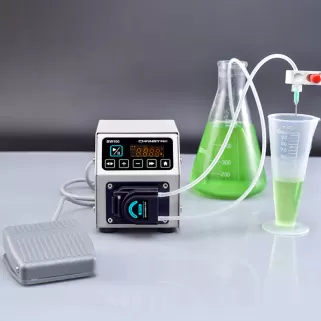
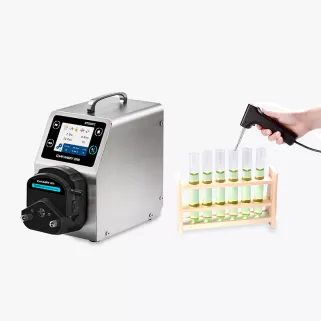
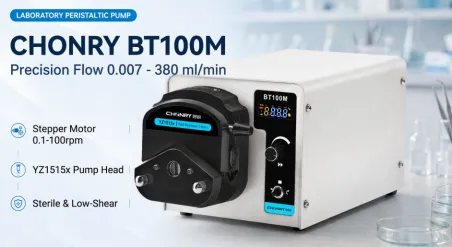
Ultimately, they turned their attention to a carefully configured multi-channel precision peristaltic pump system. This choice wasn't because it was some kind of high-tech magic, but precisely
because its principle was simple and reliable—like repeatedly squeezing a tube with your fingers to propel liquid forward. Only, it replaced fingers with precision rollers and repetitive human
movements with motors and programs.
How to Integrate "Tools" into "Workflow"
Introducing new equipment doesn't equate to solving the problem. The key is how to seamlessly integrate it into the daily routine of the lab.
The first step is division of labor.
They configured three independent pump channels for three key liquids: one specifically for delivering air-sensitive catalysts, one for managing acidic buffer solutions, and the other for
controlling alkaline buffer solutions. Each channel was designed with the most suitable tubing material, such as corrosion-resistant fluororubber tubing, based on the chemical
characteristics of the liquids.
The second step is programming, or writing the "experimental script."
They set up the following program in the computer software:
Phase 1 (0-2 hours): Commands the first channel to uniformly "push" all the catalyst into the reactor at an extremely slow rate (e.g., 41.7 μL/min). Once the researcher has set it up, they can
leave to do other work.
Phase 2 (2-5 hours): Commands the second and third channels to operate at constantly changing ratios, like two synchronized dancers, advancing and retreating, to achieve a smooth,
precise linear change in the pH of the reaction system, inducing perfect precipitation of nanoparticles.
The third step is building trust. They used the most "clumsy" yet most reliable method—an analytical balance—to repeatedly weigh and calibrate the pumped liquid. The data proved
that the difference in liquid volume delivered by the system each time was negligible. Trust was thus established.
Change happened in every detail.
The change was silent yet profound:
At 10 PM, the lab lights could finally be turned off. An experimental procedure was running automatically, completing precisely in the early morning, awaiting the researchers' results.
In the lab logbook, the description of the "catalyst addition rate" changed from the vague "slowly added" to the precise "Channel 1, 41.7 µL/min, for 120 minutes." Scientific
reproducibility became so concrete for the first time.
In the group meeting's data presentation, the particle size distribution curves became sharp and consistent, with the difference curves between different batches almost perfectly overlapping.
The focus of the discussion shifted from "Why did it fail again?" to "What would happen if we optimized the gradient slope further?"
The anxiety and fatigue on the graduate students' faces lessened. They were no longer tied to lab benches performing repetitive manual labor, but instead had more time to think about designs,
analyze data, and read literature.
The Lessons Behind the Story
What Dr. Wang's team did was essentially transform their most valuable experience—"how to precisely add liquid"—from a personal, implicit "muscle memory" into an explicit, shareable,
and infinitely reproducible "program memory" stored in a computer.




![Best Peristaltic Pump for Water Treatment Chemical Dosing [2026 Guide]](/data/watermark/20260902/6a97edf4bde65452_361.webp "Best Peristaltic Pump for Water Treatment Chemical Dosing [2026 Guide]")