Ultrafiltration (UF) is a crucial separation technology in biotechnology, pharmaceuticals, and food science, highly regarded for its ability to concentrate large molecules and purify solutions according to molecular weight.
The efficiency and reproducibility of these experiments depend not only on the choice of membrane but, more importantly, on the precise and gentle handling of sensitive feed streams. It is here that the application of
peristaltic pumps has evolved from mere convenience to a fundamental component of experimental integrity.
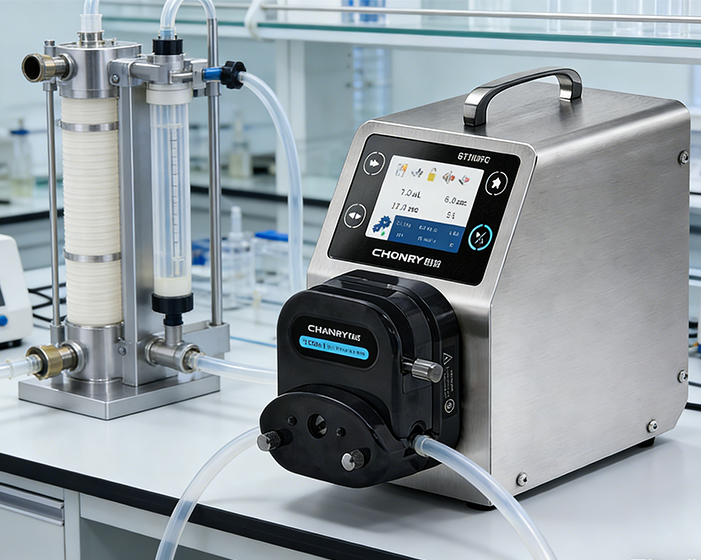
Industry Background and Market Demand
With the development of more complex biopharmaceuticals such as monoclonal antibodies and viral vectors, the demand for scalable and reliable benchtop ultrafiltration processes is growing. Laboratories require
equipment that can provide stable performance while preserving the conformational structure and bioactivity of proteins, enzymes, and cells. Traditional pumping methods, such as diaphragm pumps or centrifugal
pumps, can generate significant shear stress or pressure spikes, potentially leading to sample degradation, protein denaturation, or cell lysis. Therefore, the market increasingly demands solutions that offer better control
over fluid dynamics, prioritizing gentle operation without sacrificing precision—this is the core competitiveness of modern peristaltic pump technology.
Core Technology: How Peristaltic Pumps are Combined with Ultrafiltration Technology
The working principle of a peristaltic pump is simple and effective: rotating rollers or sliders sequentially compress a flexible tube, creating a moving blockage that propels the fluid within. This design ensures that the liquid
only contacts the inner wall of the tube, not the pump body itself. This is crucial in ultrafiltration experiments. The peristaltic pump generates the necessary transmembrane pressure (TMP) to drive the solvent and small
molecule solutes through the membrane while retaining larger molecules. Crucially, it employs a pulsed, non-shear action, minimizing foaming, heat generation, and mechanical damage to shear-sensitive components.
The flow is reversible, facilitating efficient backwashing for membrane cleaning or recovery of retained substances.
Design, Performance, and Material Considerations
The performance of a peristaltic pump in ultrafiltration (UF) depends on several engineering factors.
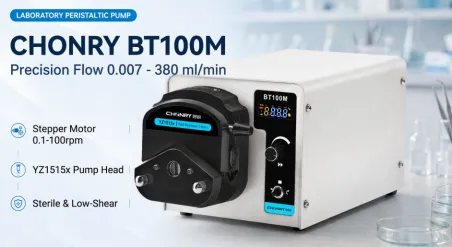
• Drive Mechanism and Control: High-precision stepper motors or servo motors enable accurate and stable flow rates, which are essential for maintaining stable transmembrane pressure (TMP). Digital interfaces support
programming of concentration, dialysis filtration, and backwash cycles.
• Pump Head Design: Multi-roller pump heads provide a smoother flow rate and reduce pulsation, which helps maintain stable filtration conditions and protect delicate membranes.
• Tubing: This is arguably the most critical consumable. For ultrafiltration applications, tubing must be chemically compatible with a wide range of buffers, solvents, and biological samples. Commonly used materials
include platinum-cured silica gel, fluoropolymers (such as PharMed® BPT), and Viton®. Their flexibility, durability, and extremely low extraction/leaching characteristics are crucial for preventing sample contamination
and ensuring pump lifespan.
• Pressure and Flow Monitoring: Advanced systems integrate pressure sensors that provide real-time transmembrane pressure differential (TMP) feedback, enabling automatic flow regulation to prevent membrane fouling
or exceeding pressure limits.
Key Factors Affecting Performance and Quality
The success of peristaltic pump applications in ultrafiltration depends on several interrelated factors.
1. Pulsation Control: While pulsation is inherent to peristaltic pumps, it can be mitigated through pump head design (increasing the number of rollers) or by incorporating pulsation dampers in the flow path. Excessive
pulsation can lead to uneven membrane loading and premature fouling.
2. Flow Accuracy and Stability: Stable flow rate is crucial for repeatable TMP. Inaccurate flow can cause variations in concentration rates and affect process control.
3. Tubing Selection and Maintenance: Incorrect tubing materials can lead to expansion, cracking, or leakage. Regular tubing replacement is essential to prevent failures and ensure the sterility of sensitive ultrafiltration
experiments.
4. System Integration and Control: Pumps must communicate effectively with other system components, such as pressure sensors and level sensors, to achieve automation and eliminate the need for manual operation,
especially in multi-step percolation processes.
Addressing Common Challenges and Industry Pain Points
One of the main challenges of ultrafiltration (UF) is membrane fouling, which reduces flux and requires membrane cleaning or replacement. Peristaltic pumps help address this issue by providing gentle, reversible flow
for periodic backwashing. Another pain point is sample loss, especially when handling valuable or small-volume materials. The closed, sterile path of a peristaltic system—where fluid only comes into contact with
disposable tubing—minimizes dead volume and improves efficiency.




![Best Peristaltic Pump for Water Treatment Chemical Dosing [2026 Guide]](/data/watermark/20260902/6a97edf4bde65452_361.webp "Best Peristaltic Pump for Water Treatment Chemical Dosing [2026 Guide]")